Sugar Production Process from Sugar Cane

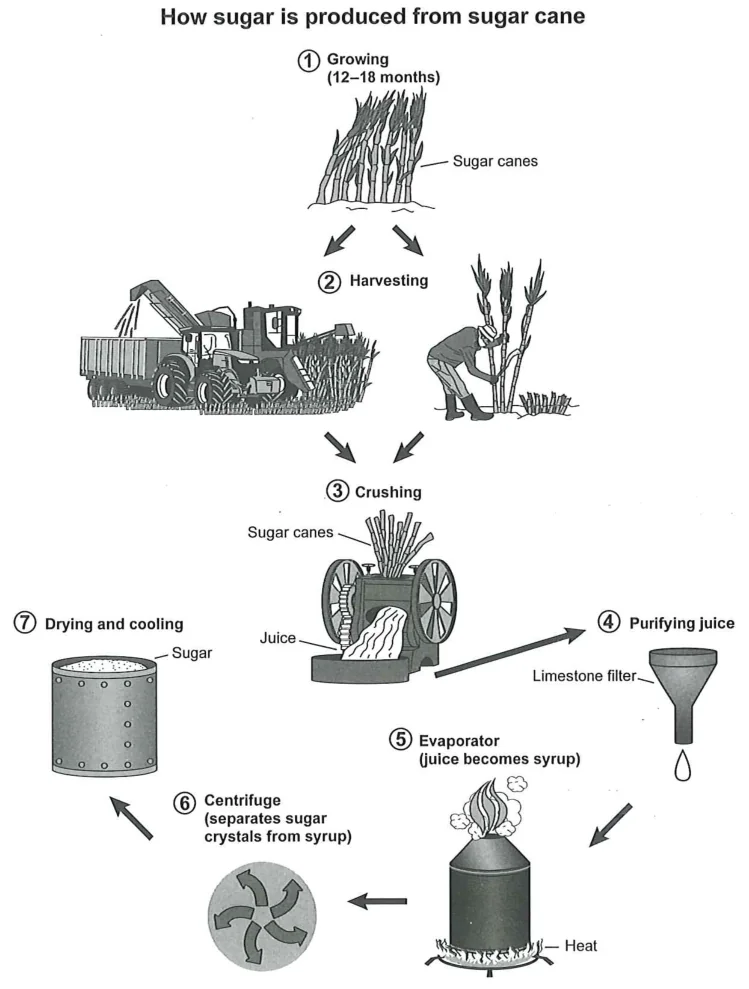
The diagram below shows the manufacturing process for making sugar from sugar cane. Summarise the information by selecting and reporting the main features, and make comparisons where relevant.

Cambridge IELTS 16 Academic Test 2 Writing Task 1 visual

Annotated response

6 correction notes

Showing 6 correction notes.

The illustrates the phases involved in producing sugar from sugar cane plants.

Generally speaking, sugar production involves seven main stages that start with growing the sugar cane on farms and culminates in drying and cooling the to form sugar which is ready to be consumed.

As the process diagram suggests, in the first step, the sugar cane plants are harvested from the farmland when they are about a year to eighteen months old. The harvesting of sugar cane plants is done either manually or with the help of agricultural machinery. After that, the sugar cane stalks are crushed in a grinder, resulting in the formation of sugar cane juice. Afterwards, this juice is purified with the use of a limestone filter. Subsequently, the juice is heated in an evaporator device. During this step, the vaporization of water creates the syrup, which is then poured into a centrifuge machine sugar crystals from the syrup. In the final stage, the created crystals are dried and cooled to manufacture the final is sugar.

Overall assessment

Why this response received Band 7.5

The strongest aspect is the accurate and complete coverage of all seven stages, supported by a clear overview and precise topic vocabulary drawn from the diagram. The main limitation is a somewhat mechanical sequence of linkers and occasional grammatical slips in the overview, which slightly reduce polish without obscuring the message.

IELTS criteria

How each score was decided

Task Achievement

8.0

The response covers all seven diagram stages accurately, including the 12-18 month growing period, both manual and mechanical harvesting, and the centrifuge separation, with a clear overview and no invented details.

Coherence and Cohesion

7.0

Progression through the process is logical and easy to follow, though the sequence relies on a chain of similar simple linkers such as after that, afterwards, and subsequently rather than more varied cohesion.

Lexical Resource

7.0

Topic-specific vocabulary is used flexibly and accurately, with terms like evaporator, limestone filter, centrifuge, and vaporization, alongside only a minor imprecision such as crystal syrup for the final product.

Grammatical Range and Accuracy

8.0

A wide range of structures is handled well, including passive voice, relative clauses, and participial results, with only occasional minor slips such as start with growing... culminates affecting agreement.