Sugar Production Process from Sugar Cane

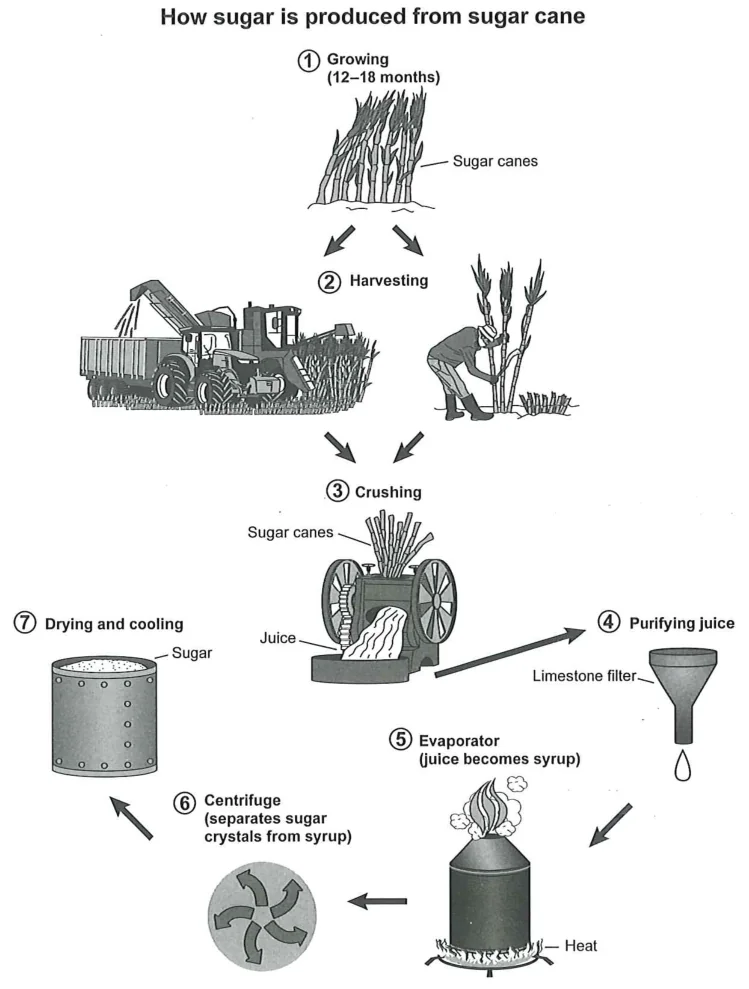
The diagram below shows the manufacturing process for making sugar from sugar cane. Summarise the information by selecting and reporting the main features, and make comparisons where relevant.

Cambridge IELTS 16 Academic Test 2 Writing Task 1 visual

Annotated response

5 correction notes

Showing 5 correction notes.

Overall, a total of seven steps is seen , including harvesting, crushing and separating. It is also evident that manufacturing sugar from sugar canes is a capital-intensive process, despite using only one ingredient.

To begin, sugar canes take 1 to 1.5 years to grow before they are ready for harvest. , either manually using a sickle or by an industrial reaper.

Once collected, the sugar canes are machine-pressed in order to extract the juice. This juice is then passed through a filter made of limestone so that any unwanted substance is eliminated. The next stage involves evaporation, in which the filtered sugar cane juice is put under heat and therefore thickens into a syrup. Subsequently, the syrup is transferred into a centrifuge, which rotates at a very high speed so that sugar crystals are separated from the liquid due to differences in density. In the final step, the sugar is dried and cooled, ready for packaging and sale.

Overall assessment

Why this response received Band 7.5

The strongest aspect of this response is its complete and accurate account of the process, with a clear overview of the seven stages and correct details such as the 12-18 month growing period and the limestone filter. The main limitation is a few slightly awkward or editorially unsupported phrasings, for example describing the process as capital-intensive with one ingredient, which are not drawn from the diagram. Language is generally flexible and precise throughout.

IELTS criteria

How each score was decided

Task Achievement

7.5

The response covers all seven stages accurately, including the growing duration, the two harvesting methods, and each transformation, with a clear overview, though the claim about a capital-intensive process with one ingredient is not directly supported by the diagram.

Coherence and Cohesion

7.5

Information is logically sequenced with effective sequencing devices such as 'to begin', 'once collected', and 'subsequently', giving clear progression, though the opening sentence is slightly strained in presentation.

Lexical Resource

8.0

Vocabulary is flexible and precise, using appropriate technical items such as 'centrifuge', 'evaporation', 'syrup', and 'extract the juice' with only minor awkwardness in word choice.

Grammatical Range and Accuracy

7.5

A wide range of structures is used, including relative clauses and passive voice, with generally good control, though occasional awkward constructions such as 'seven steps is seen from the production' reduce precision.