Sugar Production Process from Sugar Cane

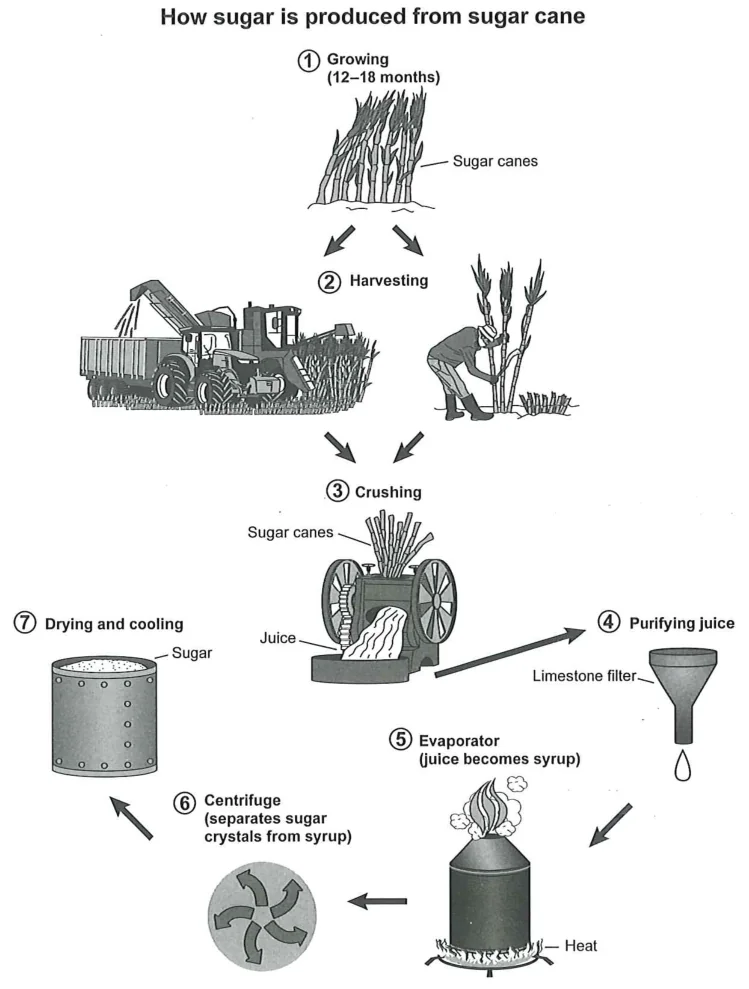
The diagram below shows the manufacturing process for making sugar from sugar cane. Summarise the information by selecting and reporting the main features, and make comparisons where relevant.

Cambridge IELTS 16 Academic Test 2 Writing Task 1 visual

Annotated response

9 correction notes

Showing 9 correction notes.

The diagram illustrates how sugar is produced from sugar cane. The entire process consists of , the first of which covers the cultivation and harvesting of sugar cane. This is followed by a series of industrial processes, namely, , which collectively convert the raw material into juice, syrup and finally the end-product itself, sugar.

By far the longest part of the process is the first. Sugar cane, after it has been left to grow , is harvested either by mechanical means using a combine harvester or manually. The harvested cane is then passed through a crusher, . This juice must be purified by filtering it through a limestone filter. After that, the purified juice is heated in an it into syrup. The next stage of the process involves separating the syrup from sugar crystals in a centrifuge.

Finally, the resultant sugar crystals are dried and cooled in storage the sugar is then ready to be packaged and sold.

Overall assessment

Why this response received Band 7.0

The strongest aspect is the flexible, accurate language used to describe a clear sequence of stages, including well-chosen passive and participle constructions. The main limitation is a small number of content slips, such as reversing what the centrifuge separates and extending the process to packaging and selling, which go slightly beyond the diagram.

IELTS criteria

How each score was decided

Task Achievement

7.0

The response covers all stages of the process with a clear overview and mostly accurate detail, but the description of the centrifuge reverses the diagram's separation of sugar crystals from syrup, and the packaging-and-selling ending is not supported by the visual.

Coherence and Cohesion

7.0

The response is logically organised with clear progression through the stages and effective use of sequencing devices, though the stray fragment 'li' and one slightly misplaced comment on stage length slightly disturb the flow.

Lexical Resource

7.0

Vocabulary is flexible and precise for a process description, with items like 'crusher', 'limestone filter', 'evaporator' and 'centrifuge' used accurately, alongside natural phrases such as 'by far the longest part'.

Grammatical Range and Accuracy

7.0

A wide range of structures is used with good control, including passives, relative clauses and participle phrases, with only rare slips such as the dangling 'turning it into syrup' and the stray 'li'.