Sugar Production Process from Sugar Cane

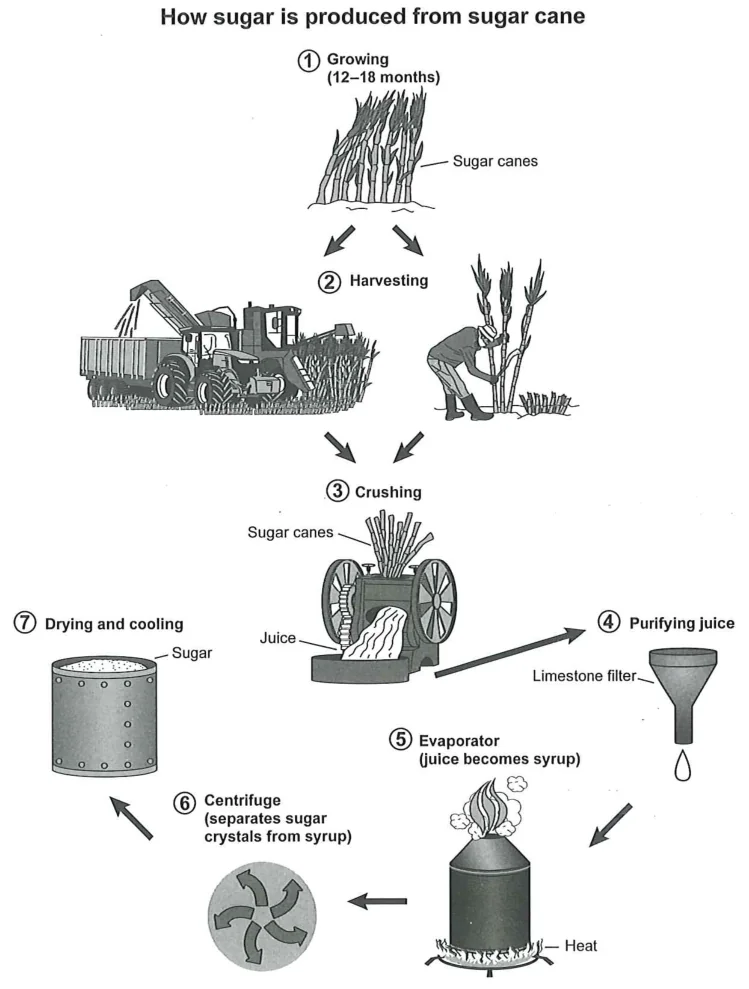
The diagram below shows the manufacturing process for making sugar from sugar cane. Summarise the information by selecting and reporting the main features, and make comparisons where relevant.

Cambridge IELTS 16 Academic Test 2 Writing Task 1 visual

Annotated response

3 correction notes

Showing 3 correction notes.

The diagram displays how sugar is manufactured from sugar cane.

Overall, it is a man-made, linear process consisting of four main stages: farming, crushing, separating and drying.

The first step is to grow sugar cane and it takes about 12 to 18 months for it to mature. After it has fully grown, it is harvested either manually or mechanically. The manual method involves , while the mechanized method uses machines to cut the canes directly.

The harvested canes are then crushed in a mill to extract the juice using a limestone filter. Next, the purified juice is boiled in an evaporator to remove water so that it is concentrated into a syrup. The syrup is then poured into a centrifuge where it is spun at high speed to separate sugar crystals from it. Finally, the crystals are dried and cooled and the end result is sugar.

Overall assessment

Why this response received Band 8.0

The response explains the complete production sequence clearly and uses accurate technical language to describe how cane becomes sugar. Its paragraphing and controlled use of passive and complex structures make the account easy to follow. The overview is less precise than the detailed description because its four broad labels do not clearly represent purification and evaporation. The harvesting explanation also specifies an order of actions that the illustration does not establish.

IELTS criteria

How each score was decided

Task Achievement

7.5

All seven illustrated stages are described in sequence, including the growing time and both harvesting methods; however, the four-part overview compresses the process unevenly, and the claimed order of leaf removal before cutting is not established by the diagram.

Coherence and Cohesion

8.0

The distinction between cultivation and subsequent processing gives the paragraphs a clear purpose, while sequencing expressions and references to juice, syrup and crystals guide the reader smoothly through the process.

Lexical Resource

8.0

Technical vocabulary such as “limestone filter,” “evaporator” and “centrifuge” is used accurately, alongside effective expressions including “extract the juice” and “concentrated into a syrup.”

Grammatical Range and Accuracy

8.0

Passive forms, time clauses, relative clauses and a result clause are used accurately and appropriately, allowing several connected operations to be explained without loss of clarity.