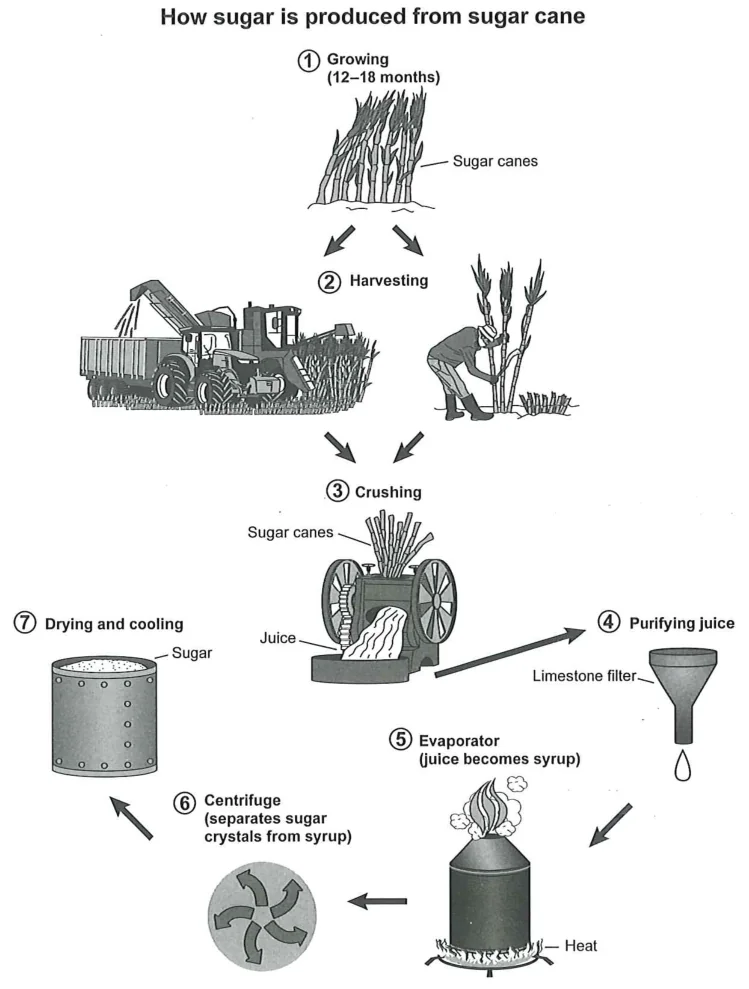
Sugar Production Process from Sugar Cane

The diagram below shows the manufacturing process for making sugar from sugar cane. Summarise the information by selecting and reporting the main features, and make comparisons where relevant.

Cambridge IELTS 16 Academic Test 2 Writing Task 1 visual

Annotated response

7 correction notes

Showing 7 correction notes.

The diagram illustrates how sugar is produced from

, there are seven various stages in this process demanding specific machinery and skilled workers.

First of all, in appropriate farmland. (perhaps depending on the culture conditions as well as the types of sugar can), the crops are harvested either mechanically by trucks or physically by farmers. At the next step, sugar cans a machine with two rotating wheels in which sugar is completely crushed so that its juice is extracted.

Subsequently, the extracted juice is passed through a limestone filter forpurification. While the purified juice is being heated, its liquid evaporates. Therefore, the juice becomes syrup. At this point, a centrifuge is needed to separate sugar crystals from the syrup. Once the syrup has been centrifuged for a certain time, it is eventually dried and cooled in big containers. The final substance is a substance which is called sugar.

Overall assessment

Why this response received Band 7.0

The response covers all seven stages of the process accurately with a clear overview and logical sequencing, which is its strongest aspect. The main limitation is occasional imprecise or repetitive word choice, such as the recurring confusion of 'cans' for 'canes' and the vague final sentence.

IELTS criteria

How each score was decided

Task Achievement

7.0

The response covers all seven stages with accurate details such as the 12–18 month growing period and both harvesting methods, and includes a clear overview, though speculative commentary and the weak closing sentence slightly reduce precision.

Coherence and Cohesion

7.0

The process is sequenced logically with a range of cohesive devices and clear stage progression, with only occasional mechanical transitions.

Lexical Resource

7.0

Vocabulary is generally flexible and appropriate for describing a process, but some imprecise word choices such as 'sugar cans', 'culture conditions', and the repetitive 'substance' phrasing limit precision.

Grammatical Range and Accuracy

7.0

A good range of structures, including passive and complex forms, is used with mostly accurate control, though there are occasional awkward constructions such as 'As clearly can be seen'.