Sugar Production Process from Sugar Cane

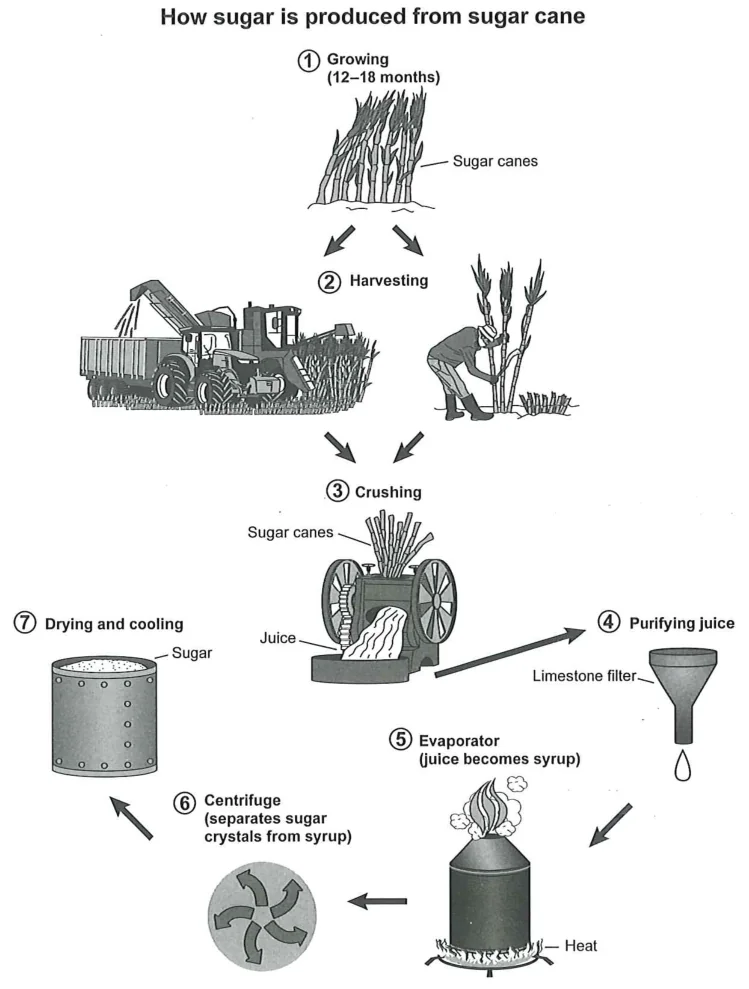
The diagram below shows the manufacturing process for making sugar from sugar cane. Summarise the information by selecting and reporting the main features, and make comparisons where relevant.

Cambridge IELTS 16 Academic Test 2 Writing Task 1 visual

Annotated response

15 correction notes

Showing 15 correction notes.

The demonstrates from sugar cane.

Overall, it can be seen that the has several stages from growing sugar cane

In the first stage, making sugar cane was primarily a requirement and it took 12 to 18 months to grow. is harvesting which can be done by two methods, either harvest by labour or by a machine such as a tractor. In the third stage, by machines In the fourth stage, purifying in limestone filter later stored into the container and give heat thus, juice turn into syrup, this stage also knows as an evaporator. The sixth stage is sugar crystals In the last stage, drying as well as cooling

Overall assessment

Why this response received Band 5.5

The strongest aspect is complete stage-by-stage coverage of the sugar production process in a logical sequence, with all seven stages from growing to drying and cooling represented. The main limitation is frequent grammatical and vocabulary errors, including misspellings and imprecise wording, which sometimes obscure the intended meaning.

IELTS criteria

How each score was decided

Task Achievement

5.5

All seven stages of the process are addressed with a clear overview of the sequence, but some details are inaccurate or imprecise, such as describing crushing output as 'juice and particles' and the centrifuge separating crystals from 'the strip' rather than syrup.

Coherence and Cohesion

5.5

The response follows the process order with basic sequencing devices, but progression is at times mechanical and some sentences run on or lack clear links between stages.

Lexical Resource

5.0

Vocabulary is sufficient to describe the process but limited in range, with misspellings such as 'Joice', awkward phrasing like 'making sugar cane was primarily a requirement', and imprecise terms such as 'strip'.

Grammatical Range and Accuracy

5.0

A mix of simple and attempted complex structures is present, but frequent errors, including faulty passive forms ('harvested sugar can crush'), run-on sentences, and subject-verb problems, sometimes impede meaning.