Sugar Production Process from Sugar Cane

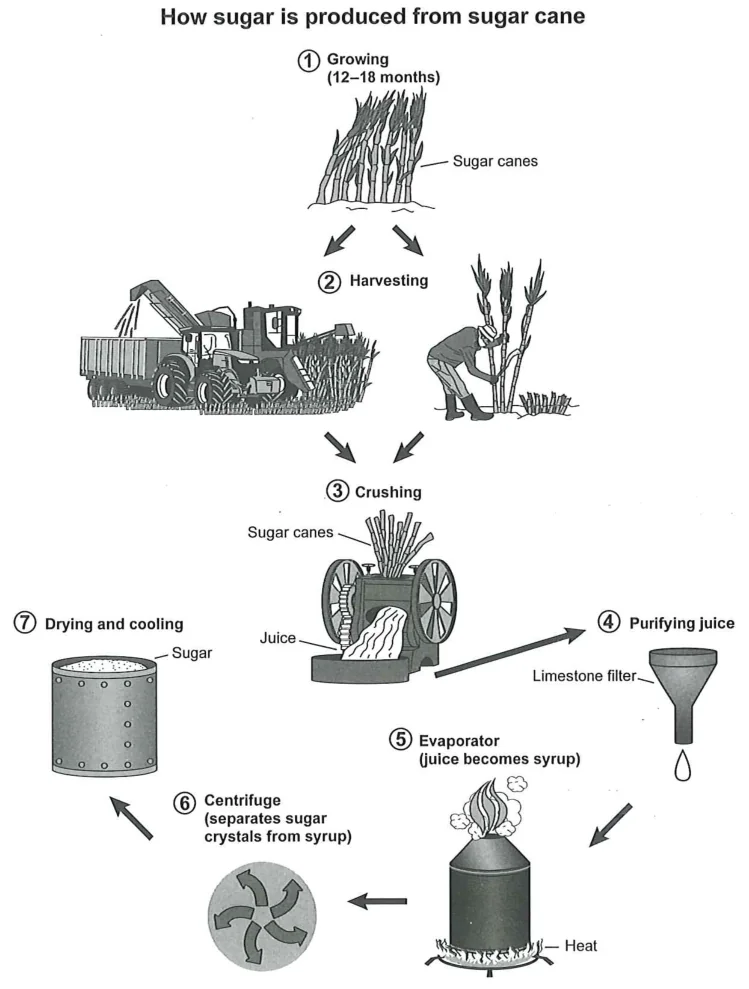
The diagram below shows the manufacturing process for making sugar from sugar cane. Summarise the information by selecting and reporting the main features, and make comparisons where relevant.

Cambridge IELTS 16 Academic Test 2 Writing Task 1 visual

Annotated response

4 correction notes

Showing 4 correction notes.

The diagram delineates the seven-stage manufacturing process of sugar from sugarcane, beginning with its cultivation and the refined sugar product.

A glance at the illustration reveals that the process is raw sugarcane into a consumable product through a series of mechanical and chemical treatments, including crushing, purification, heating, and crystallisation.

The production cycle commences with the cultivation of sugarcane on farms, a process that typically spans between twelve and eighteen months. Once mature, the sugarcane is harvested, either manually or using machinery, and subsequently transported for processing. The initial processing step involves crushing the sugarcane stalks in a grinder, which extracts the raw sugarcane juice.

Following this, the extracted juice undergoes purification using a limestone filter to remove impurities. The purified juice is then transferred to an evaporator, where it is heated, leading to the vaporisation of water and the formation of a concentrated syrup. This syrup is then introduced into a centrifuge machine, which effectively separates the sugar crystals from the liquid. In the final stages, these newly formed sugar crystals are meticulously dried and cooled, culminating in the production of the finished sugar product ready for consumption.

Overall assessment

Why this response received Band 8.0

The response covers all seven stages of the process accurately and in the correct sequence, with a clear overview and precise stage-by-stage detail. Its main limitation is that it stays close to narrating the diagram without drawing comparisons, such as between manual and mechanical harvesting, though this is a minor constraint given the linear nature of the task.

IELTS criteria

How each score was decided

Task Achievement

8.0

All seven stages are reported accurately and in order, including the 12-18 month growing period and the limestone filter, with a clear overview of the linear process; only comparison is limited by the largely sequential source material.

Coherence and Cohesion

8.0

The response is cohesively organised paragraph by paragraph, with logical progression and well-managed sequencing devices such as 'following this' and 'in the final stages'.

Lexical Resource

8.0

Vocabulary is flexible and precise, using accurate process terminology like 'centrifuge', 'crystallisation', 'vaporisation', and 'purified' without noticeable inaccuracy.

Grammatical Range and Accuracy

8.0

A wide range of structures is used with flexibility and control, including passives, participle clauses, and relative clauses, with only rare minor slips.