Electrical Appliance Ownership and Housework Time

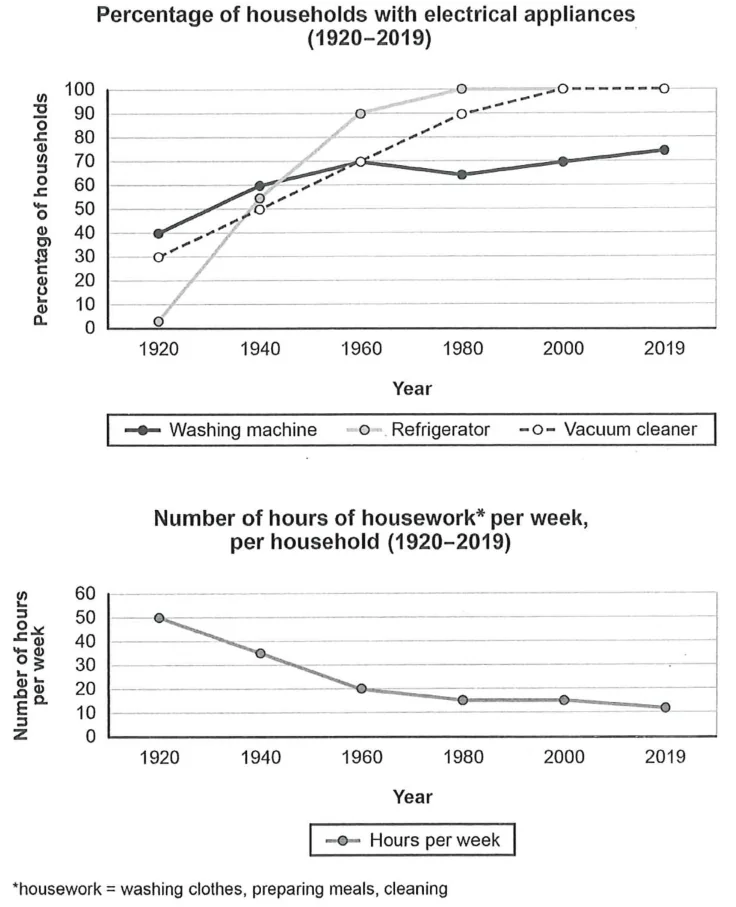
The charts below show the changes in ownership of electrical appliances and amount of time spent doing housework in households in one country between 1920 and 2019. Summarise the information by selecting and reporting the main features, and make comparisons where relevant.

Cambridge IELTS 16 Academic Test 1 Writing Task 1 visual

Annotated response

8 correction notes

Showing 8 correction notes.

The first graph displays the percentages of households that owned electrical appliances in one country between 1920 and 2019, while the second graph illustrates how much time households in that country spent doing housework during the same period.

Overall, ownership of all three appliances increased during this period, with that of refrigerators the greatest growth. At the same time, the amount of time spent on housework decreased.

Washing machines were the most common of the three electrical appliances in 1920, with ownership reaching 40% . then rose to about 75% in 2019, with a small dip in 1980. Nearly a third of households owned vacuum cleaners in 1920. Although ownership climbed steadily, it did not reach 100% until 2000.

In comparison, almost no households had a refrigerator in 1920. However, ownership increased rapidly and by 1980 .

first fell significantly from 50 to 15 hours per week between 1920 and 1980. After that, it to just over 10 hours a week in 2019.

Overall assessment

Why this response received Band 7.5

The response selects all key features accurately, comparing appliance ownership trends and the decline in housework hours with well-chosen supporting data. Its main limitation is a somewhat limited range of descriptive vocabulary and occasionally repetitive sentence patterns rather than any weakness in content or accuracy.

IELTS criteria

How each score was decided

Task Achievement

8.0

The response covers all key features of both charts with a clear overview, accurate data (40% washing machines in 1920, refrigerators reaching 100% by 1980, housework falling from 50 to just over 10 hours), and relevant comparisons, with only a minor imprecision in describing ownership as a percentage of the population.

Coherence and Cohesion

7.5

Information is organised logically with a clear introduction, overview, and separate body paragraphs for appliances and housework, supported by cohesive devices such as 'In comparison' and 'by contrast' that guide the reader smoothly.

Lexical Resource

7.5

Vocabulary is generally flexible and appropriate for describing trends and proportions, with good use of items like 'climbed steadily' and 'a small dip', though the range of trend verbs and modifiers remains somewhat limited and occasionally repetitive.

Grammatical Range and Accuracy

7.5

A variety of complex structures, including relative clauses and contrastive constructions, is used with good control, and errors are rare and non-impeding, such as the slightly awkward 'with that of refrigerators having the greatest growth'.