Plastic Bottle Recycling Process Diagram

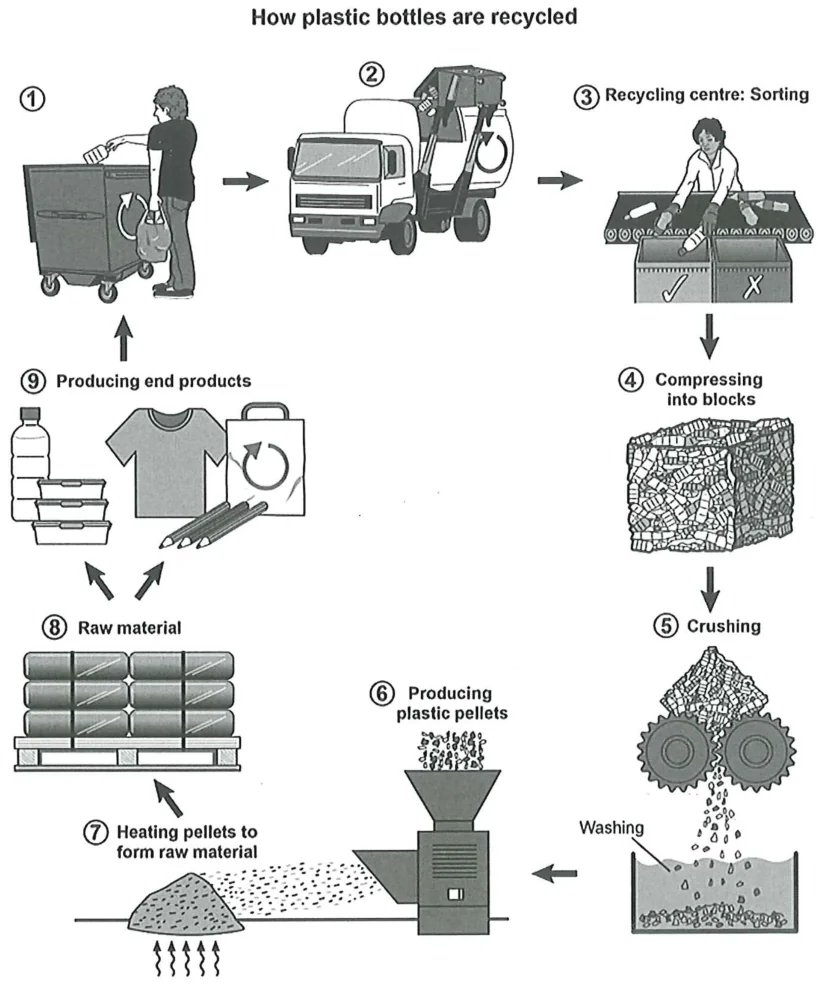
The diagram below shows the process for recycling plastic bottles. Summarise the information by selecting and reporting the main features, and make comparisons where relevant.

Cambridge IELTS 16 Academic Test 4 Writing Task 1 visual

Annotated response

8 correction notes

Showing 8 correction notes.

The diagram demonstrates in the plastic bottle recycling process.

process consists of nine main phases, commencing with the disposal of plastic bottles and culminating with the production of .

discard used plastic bottles in designated . These bottles are subsequently collected by trucks and transported to a recycling center. At the center, the bottles undergo a sorting process to separate recyclable bottles from non-recyclable ones, which are removed from the line. Once sorted, the selected bottles are compressed into dense blocks to facilitate easier handling and processing. In the next step, these compressed blocks are broken down into smaller pieces. During the fifth stage, the crushed plastic pieces are thoroughly washed with water to remove any impurities and prepare them for further recycling steps.

the plastic pieces are fed into a machine that transforms them into pellets. These pellets are then heated to produce raw materials, which are subsequently stored and utilized to manufacture various products, such as plastic containers, . This recycling process is repeated each time bottles are used and discarded.

Overall assessment

Why this response received Band 8.0

The response's strongest aspect is its complete, accurate coverage of all nine stages with a clear overview and well-chosen sequencing language. The main limitation is minor: a few descriptions add slight interpretation beyond the diagram, such as naming specific end products, though these remain broadly consistent with the visuals.

IELTS criteria

How each score was decided

Task Achievement

8.0

The response covers all nine stages from disposal to end products in the correct order, with a clear overview of the cycle's start and finish, and only minor interpretive additions such as listing end-product examples.

Coherence and Cohesion

8.0

Ideas progress logically through the process with cohesive devices like 'subsequently', 'once sorted', and 'in the next step' used naturally, giving a clear and effortless progression.

Lexical Resource

8.0

Vocabulary is flexible and precise for a process task, using items such as 'designated rubbish bins', 'compressed into dense blocks', 'impurities', and 'pellets', with only rare imprecision.

Grammatical Range and Accuracy

8.0

A wide range of structures, including passives, participle clauses, and relative clauses, is used with flexibility and accuracy, and errors are rare and non-impeding.