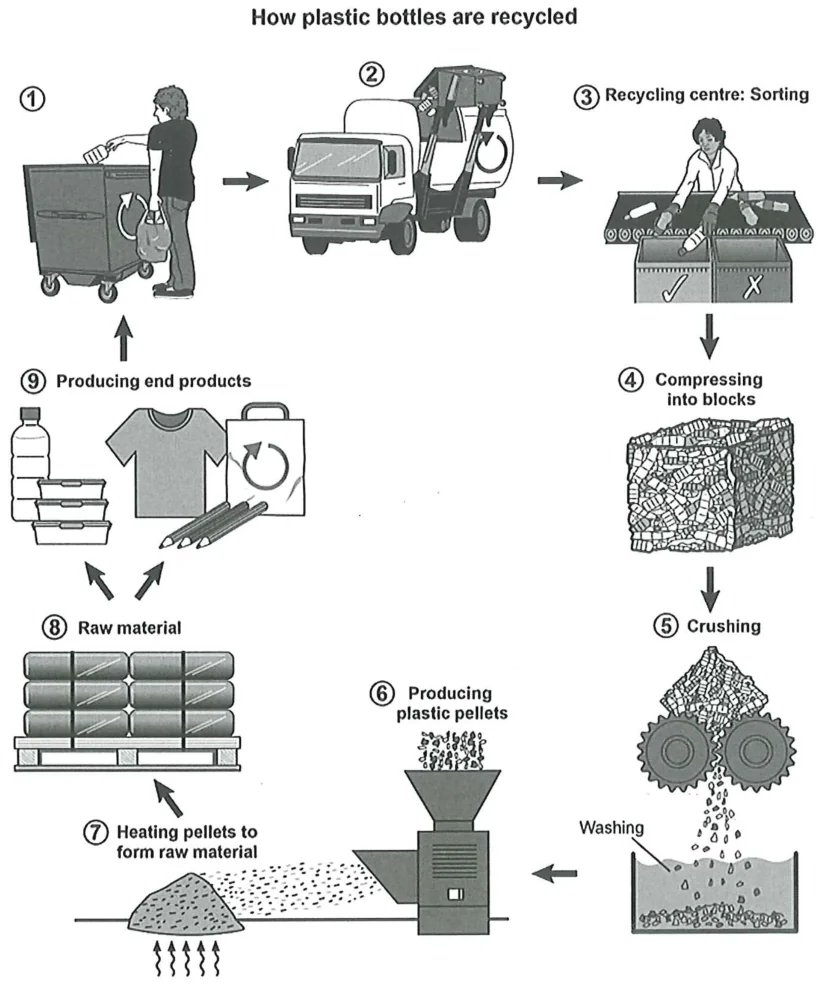
Plastic Bottle Recycling Process Diagram

The diagram below shows the process for recycling plastic bottles. Summarise the information by selecting and reporting the main features, and make comparisons where relevant.

Cambridge IELTS 16 Academic Test 4 Writing Task 1 visual

Annotated response

8 correction notes

Showing 8 correction notes.

The diagram depicts the sequential process involved in recycling plastic bottles.

the recycling of plastic bottles is a cyclical and multi-stage process that begins with people discarding used plastic bottles and ends with the production of new plastic items. The process highlights the systematic transformation of plastic waste into reusable goods.

Initially, when used plastic bottles are discarded into recycling bins by they are collected by garbage trucks, which transport to a recycling facility. At the facility, workers The selected plastic bottles are then compressed into blocks using compacting equipment. Following this, the compacted blocks are into small plastic fragments, which are subsequently washed to remove impurities. The clean plastic pieces are then poured into machines to produce plastic pellets. In the next step, those pellets are heated and processed to turn them into raw materials. These raw materials are then ready to be used to manufacture a wide variety of plastic products such as clothes, containers, and bottles. Once those goods are used and discarded in the plastic recycling process is repeated.

Overall assessment

Why this response received Band 8.0

The response covers all nine stages of the process in the correct sequence with a clear overview and accurate detail, and it closes the cycle appropriately. Its main limitation is a somewhat repetitive style and minor imprecision in a few stage descriptions, such as the pellet-to-raw-material transition.

IELTS criteria

How each score was decided

Task Achievement

8.0

The response covers every stage of the diagram in accurate order, provides a clear overview identifying a cyclical, multi-stage process, and adds no invented content, with only minor looseness in describing how pellets become raw material.

Coherence and Cohesion

8.0

Ideas progress logically through clearly signalled sequencing devices such as initially, following this, and subsequently, giving a cohesive account, though linking is at times mechanical and repetition slightly reduces range.

Lexical Resource

7.5

Vocabulary is flexible and precise for a process description, with apt items like compacted, shredded, fragments, impurities, and pellets, with only occasional redundancy.

Grammatical Range and Accuracy

8.0

A wide range of structures is used, including effective passives and relative clauses, with consistent accuracy and only rare, non-impeding slips.