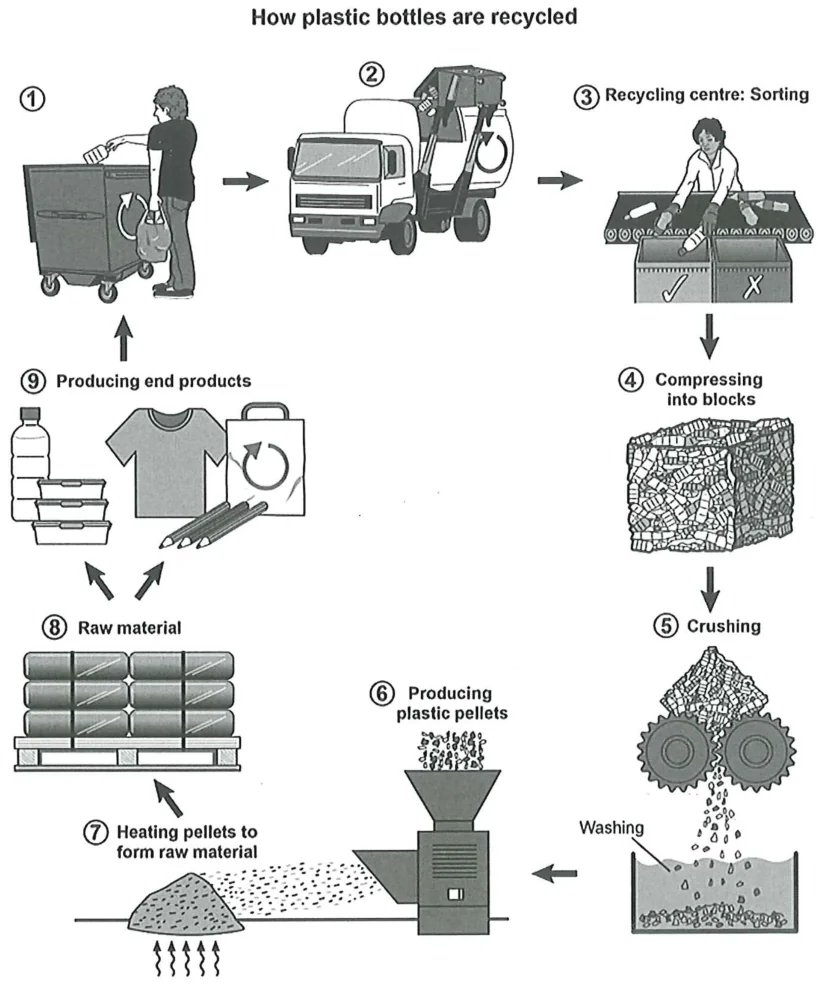
Plastic Bottle Recycling Process Diagram

The diagram below shows the process for recycling plastic bottles. Summarise the information by selecting and reporting the main features, and make comparisons where relevant.

Cambridge IELTS 16 Academic Test 4 Writing Task 1 visual

Annotated response

12 correction notes

Showing 12 correction notes.

The the .

Overall, it can be seen that this is a ; plastic bottles recycling has various stages, from collecting the plastic to making products.

In the first stage, collect plastic bottles from dustbin thrown by a citizen, this work is done by trucks or lorry. In the third stage, the collected . In the next stage, those bottles are recyclable, and those make into blocks by compressing and later crushed by a machine. As a result, they turn into plastic pieces that .

In the sixth stage, for producing plastic pellets grinding washed plastic pieces after that yield specific heat. In the eighth stage, it becomes which plastic items or other products such as a t-shirt. After this stage, people after usage, .

Overall assessment

Why this response received Band 5.5

The response covers the main recycling operations and gives a useful sense of the process returning to its starting point. Its chronological structure makes the broad sequence accessible. The main limitation is sentence control: missing passive auxiliaries and incomplete clauses make several operations harder to understand, especially the production and heating of pellets. Some inaccurate vocabulary also weakens otherwise relevant descriptions.

IELTS criteria

How each score was decided

Task Achievement

6.0

The response identifies the overall recycling cycle and follows the main stages from collection to new products. However, the explanation of pellet production and heating is unclear, especially in "after that yield specific heat", so the transformation into raw material is not accurately explained.

Coherence and Cohesion

5.5

The paragraphs and stage markers establish a generally clear sequence from collection to manufacture. Connections within sentences are less controlled, particularly in the pellet-production paragraph, and references such as "those make into blocks" require the reader to infer the intended relationship.

Lexical Resource

5.0

There is sufficient process vocabulary, including "compressing", "crushed" and "plastic pellets", to convey the main operations. Inaccurate choices such as "cyclone process", "row material" and "by labour" reduce precision and naturalness.

Grammatical Range and Accuracy

4.5

The response attempts relative clauses and passive forms, but errors recur in constructions such as "the collected bottles sort" and "those make into blocks". Missing auxiliaries and incomplete clause structures sometimes obscure how the stages operate.