Plastic Bottle Recycling Process Diagram

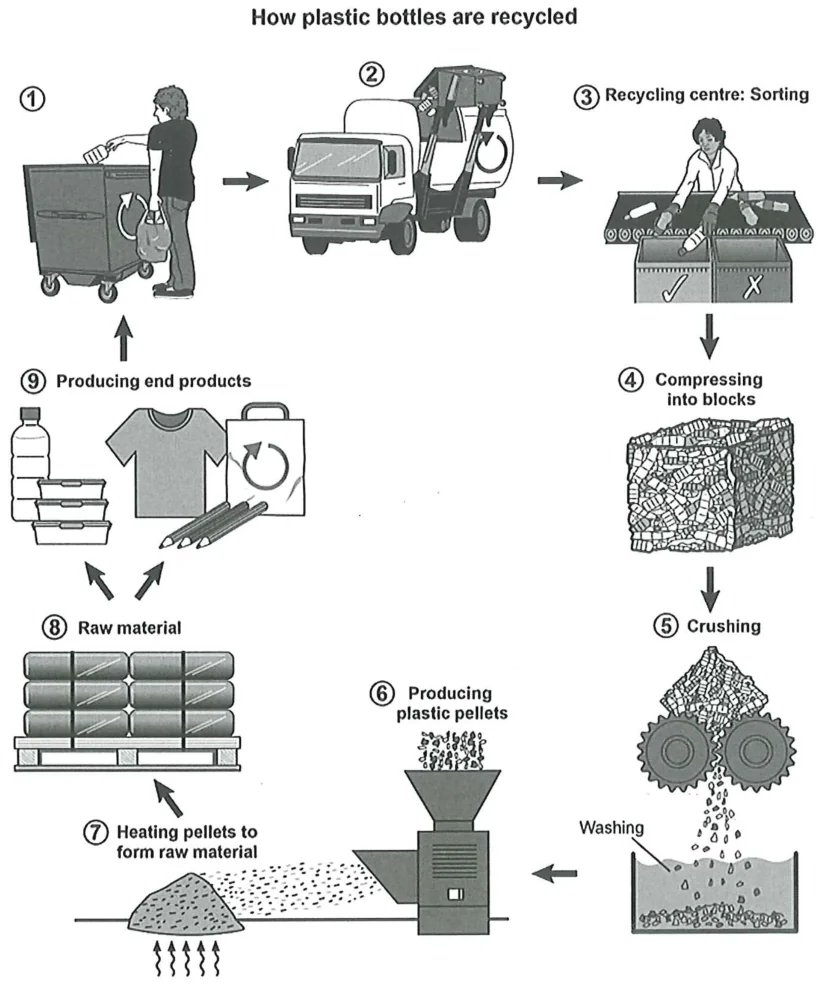
The diagram below shows the process for recycling plastic bottles. Summarise the information by selecting and reporting the main features, and make comparisons where relevant.

Cambridge IELTS 16 Academic Test 4 Writing Task 1 visual

Annotated response

13 correction notes

Showing 13 correction notes.

The given flow chart illustrates the various stages involved in recycling plastic bottles to create new products. In total, there are in the recycling process: collecting, sorting, shredding, melting, reforming, and finally, creating new products.

used plastic bottles are collected and transported to a recycling center, where they are sorted . The sorting stage is crucial to ensure that only the appropriate types of plastic are used for recycling purposes.

Following this, the plastic bottles are shredded into small pieces, which are then melted down . The melted plastic is then molded into small pellets, which can be utilized in the production of various new products such as .

Comparing the different stages of the process, it is evident that the sorting stage is the most significant as it guarantees the appropriate materials are used for recycling. Furthermore, the shredding and melting stages are equally important as they break down the plastic bottles into a usable form.

In conclusion, the flow chart effectively depicts of recycling plastic bottles. By collecting, sorting, shredding, melting, reforming, and manufacturing the plastic bottles, they are transformed into new products,

Overall assessment

Why this response received Band 7.0

The response is clearly organised and written in accurate, fluent language with a good range of vocabulary and grammar. Its main limitation is accuracy against the diagram: the stated six-stage sequence omits or misrepresents several stages shown, such as compression into blocks, washing, and the correct position of pellet production, weakening task achievement.

IELTS criteria

How each score was decided

Task Achievement

6.0

The response presents a mostly clear account of the process but inaccurately claims six stages when the diagram shows nine, omits compressing into blocks and washing, and misplaces pellet production, so key features are covered incompletely and with some inaccurate detail.

Coherence and Cohesion

7.0

Ideas progress logically through a clear introduction, staged body paragraphs, and a conclusion, with cohesive devices such as 'to begin with' and 'following this' used appropriately and naturally.

Lexical Resource

7.0

Vocabulary is flexible and precise for a process description, with terms like 'shredded', 'molded into small pellets', and 'sequential' used accurately, allowing clear and fluent expression.

Grammatical Range and Accuracy

7.0

A wide range of structures is deployed, including effective passive voice for process stages, well-controlled complex sentences, and only minor, non-impeding errors.