
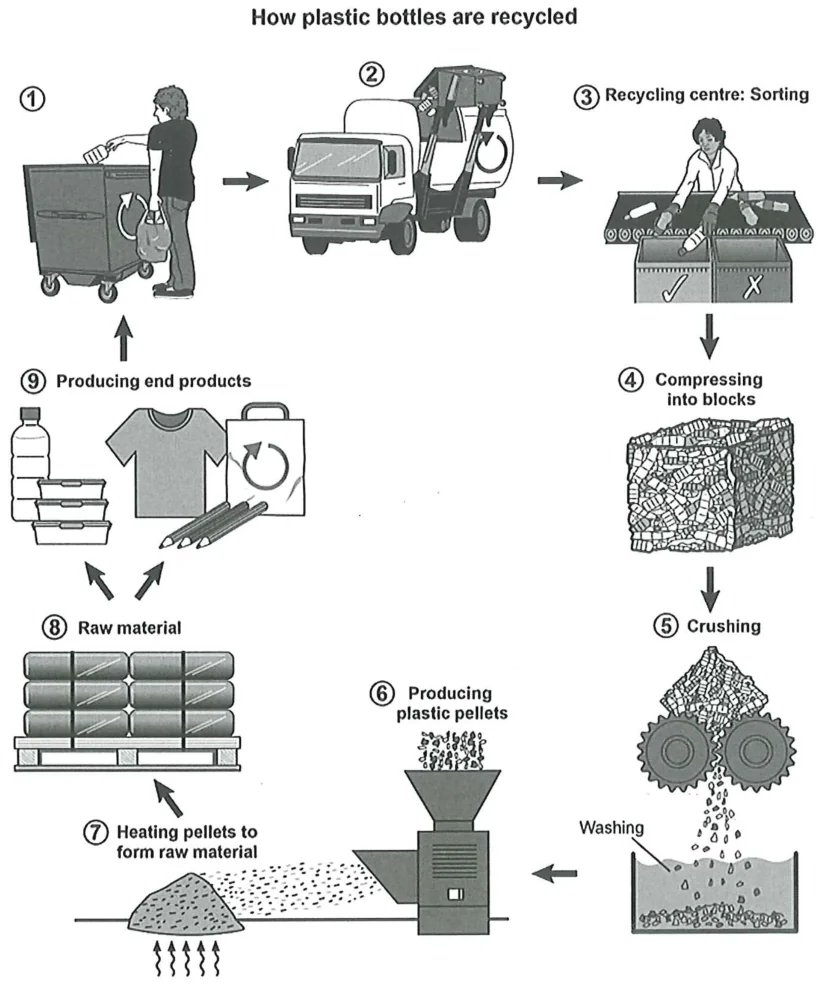
The process diagram the nine-stage process involved in recycling plastic bottles - beginning with consumers discarding them and culminating in the production of new consumer plastic products.
Overall, plastic bottle recycling is a circular system where used bottles are transformed into raw materials for a variety of new items, which can then be recycled again.
consumers depositing used plastic bottles into designated recycling bins. These bottles are subsequently collected and transported to . Upon arrival, the bottles undergo a in which workers manually separate recyclable plastics from other waste. Following this, the sorted bottles are compressed into large, compact blocks, which are then fed . This mechanical breakdown yields small plastic fragments.
These fragments are thoroughly washed to ensure purity before being introduced into a machine that produces plastic pellets. In the next stage, these pellets are subjected to heat, forming the raw material essential for manufacturing a diverse range of plastic-based goods. Finally, these refined raw materials are rolled out to produce various end products, such as t-shirts, , and new plastic bottles or containers, thus completing the cycle as these products will eventually be recycled once again.