Plastic Bottle Recycling Process Diagram

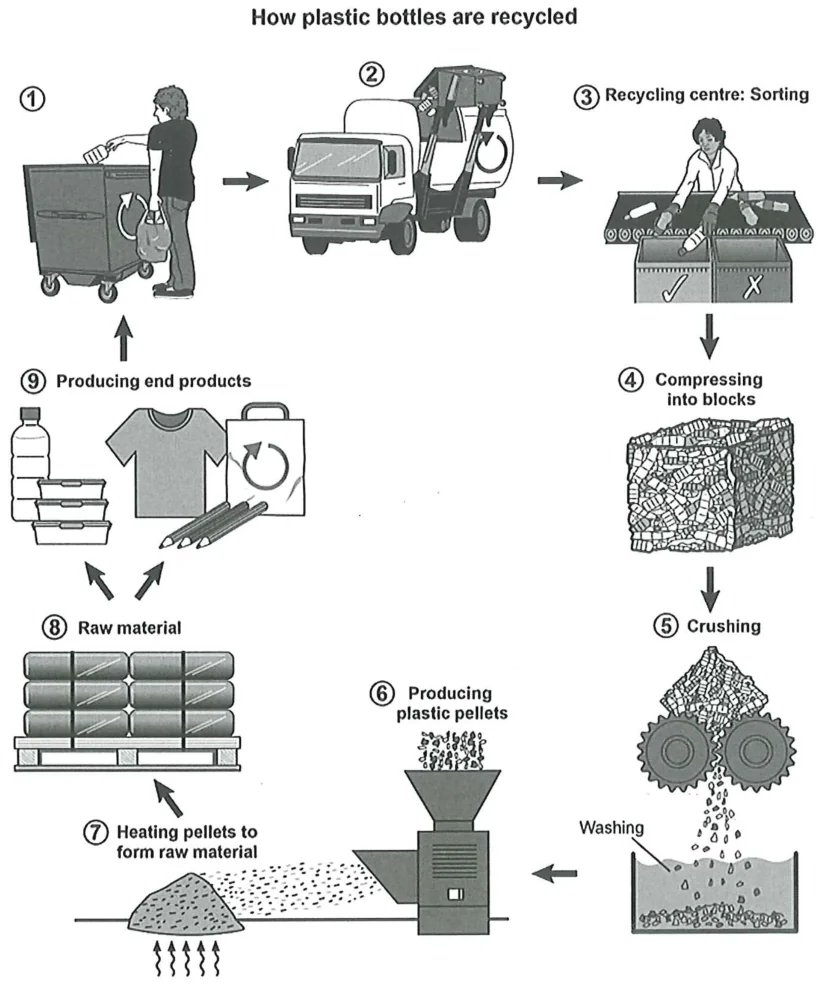
The diagram below shows the process for recycling plastic bottles. Summarise the information by selecting and reporting the main features, and make comparisons where relevant.

Cambridge IELTS 16 Academic Test 4 Writing Task 1 visual

Annotated response

7 correction notes

Showing 7 correction notes.

The diagram illustrates how plastic bottles are recycled.

Overall, the recycling of plastic bottles is a man-made, cyclical process that consists of use, collection, sorting, crushing, cleaning, pelletizing, making new plastic products, and reuse.

After plastic bottles are used, they are discarded in recycling bins, to a recycling plant. Once there, they are sorted and are compressed into blocks. The blocks are then into small pieces, which are subsequently cleaned to remove any residue.

The produced in the last stage are then poured into a machine where they are turned into pellets. The machine also heats and melts the pellets, which creates plastic raw material. Finally, the raw material is made into different plastic products, including . After these products are used, they go through the recycling process all over again.

Overall assessment

Why this response received Band 7.5

The strongest aspect is the accurate, complete coverage of all nine stages of the recycling process, delivered with a clear overview and well-chosen sequencing language. The main limitation is that the language, while controlled, remains somewhat functional rather than flexible or precise, with a modest range of vocabulary and structures.

IELTS criteria

How each score was decided

Task Achievement

8.0

The response covers all stages of the diagram accurately, from use and collection through sorting, compressing, crushing, washing, pelletizing, heating, and end products, with a clear overview of the cyclical process and no invented details.

Coherence and Cohesion

7.0

The response is logically sequenced and coherently linked with a range of cohesive devices such as 'once there', 'subsequently', and 'finally', though progression is achieved somewhat mechanically in places.

Lexical Resource

7.0

Vocabulary is sufficiently flexible for the task, using appropriate process terms like 'compressed into blocks', 'pellets', and 'residue', but the lexical range is competent rather than wide or sophisticated.

Grammatical Range and Accuracy

7.0

A variety of complex structures, including relative clauses and passive voice, is used with good control and only rare minor errors, supporting clear communication throughout.