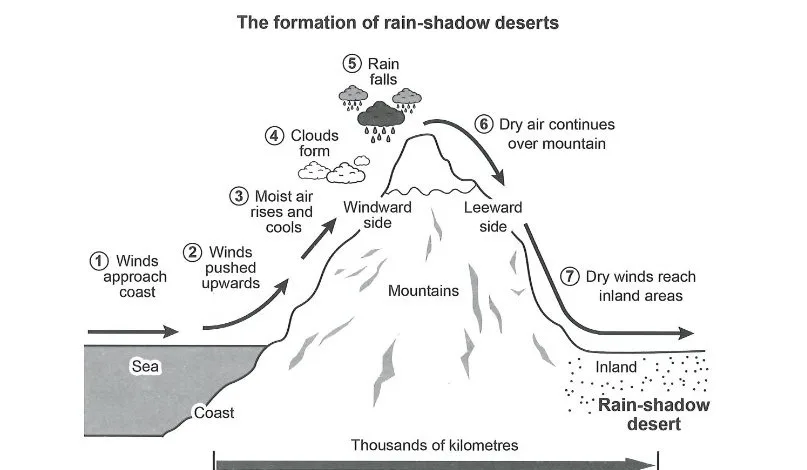
The diagram below shows how one type of desert, known as a rain-shadow desert, is formed.
Summarise the information by selecting and reporting the main features, and make comparisons where relevant.
Read an accessible description
Cambridge IELTS 21 Academic Test 3 Writing Task 1 visual
The provided illustration depicts the formation of a rain-shadow desert.
Overall, it is evident that this sequential process involves seven distinct stages, commencing with the approach of coastal winds and culminating with the development of arid inland winds.
The process begins as winds from the sea blow towards the coast. Upon encountering a mountain range, these winds are forced upwards along the windward side. Once ascending to higher altitudes, close to the summit, the moist air cools down, causing the condensation of water vapour and the resultant formation of clouds and rain on the windward slope. This depletes the air of its moisture.
Having lost the moisture, the dry air descends down the leeward side. As the dry winds reach the low-lying inland regions, they create an environment devoid of moisture. The persistent shortage of rainfall over thousands of kilometres, as a result, induces the development of a rain-shadow desert.
TA Task AchievementCC Coherence & CohesionLR Lexical ResourceGRA Grammatical Range & Accuracy
From essays on this question
Useful vocabulary
blow towards the coast
Meaning
Move through the air towards the land beside the sea.
From the essay
The process begins as winds from the sea blow towards the coast.