UK Fruit and Vegetable Consumption Rates

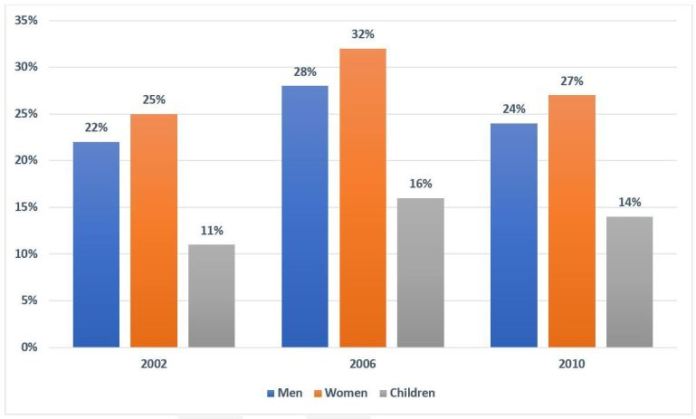
The chart below shows the percentage of the population in the UK who consumed the recommended daily amount of fruits and vegetables in 2002, 2006 and 2010.

IELTS Academic Writing Task 1 question image

Annotated response

3 correction notes

Showing 3 correction notes.

The chart illustrates the percentage of men, women and children who consumed the recommended amount of fruit and vegetables on a daily basis in three different years.

Overall, women came out first fruit and vegetable consumption while the opposite was true for children.

In all three years, there was a small difference in the percentage of males and females who consumed enough fruit and vegetables every day. The highest figure for women was 32% in 2006 compared to 28% of men. 2010 witnessed the second highest rank for both women and men’s figures. While 27% of women consumed fruit and vegetables, the percentage of men was 24%. And the smallest figure for both women and men, which was nearly the same as the 2010 figures, was recorded in 2002.

The smallest percentage of people consuming the daily recommended amount of fruit and vegetables half as much as that of men and women in the same year. Following that, the figure for children slightly increased to 16% in 2006 before falling marginally to 14% in the last year.

Overall assessment

Why this response received Band 7.0

The report gives a clear overview of the highest and lowest groups and describes the main changes with generally controlled language. Its principal factual error is the claim that children’s 11% in 2002 was half the figure for both men and women; that comparison is correct only for men.

IELTS criteria

How each score was decided

Task Achievement

7.0

The response reports the main group patterns and several accurate figures, but 11% for children in 2002 is half of the 22% for men, not half of the 25% for women. This makes the stated comparison with both adult groups inaccurate.

Coherence and Cohesion

7.0

The overview and separate adult and child discussions provide clear organisation. Some ranking language makes the adult comparisons less direct than simply giving the year-by-year proportions, but the progression remains understandable.

Lexical Resource

7.0

Vocabulary is flexible and appropriate for describing data, using terms like 'witnessed', 'marginally', and 'slightly', with only a small slip such as 'in term of'.

Grammatical Range and Accuracy

7.0

A good range of structures, including complex and comparative sentences, is used with generally strong control and only occasional minor errors that do not affect clarity.