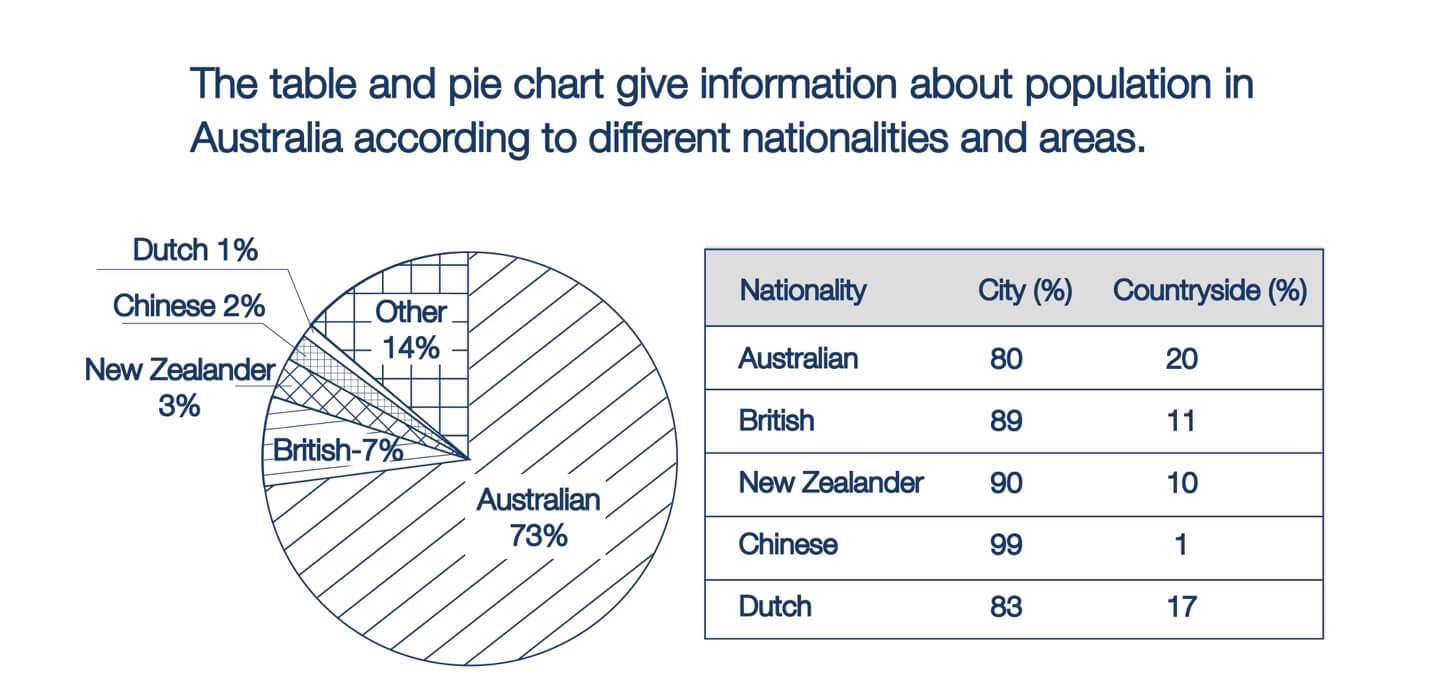
Australia Population by Nationality and Area

The table and pie chart give information about the population in Australia according to different nationalities and areas.

IELTS Academic Writing Task 1 question image

Annotated response

6 correction notes

Showing 6 correction notes.

The given pie chart shows the percentage of people of different nationalities residing in Australia , while the table shows demographic figures which are classified according to urban and rural areas.

Overall, Australians are the almost three-quarters of , and they tend to live in the urban area. This figure is followed distantly by other citizens who are almost twice the residents from Great Britain (7%), New Zealanders at 3%, Chinese at 2%, and people from the Netherlands at just 1%.

It is readily apparent that , whereas only 1% live in the countryside. The other vast majority of city dwellers is New Zealanders and British, which display nearly identical proportions around 90%. In terms of living areas, Australians are few likely to live outside the cities, , while the rest still live in urban environments. Similarly, 83% of the Dutch live in cities and 17% in the countryside.

Overall assessment

Why this response received Band 7.0

The response covers both visuals, presents a clear overview, and reports most data accurately, which is its strongest aspect. The main limitation is recurring grammatical and word-choice inaccuracy, such as 'few likely to live' and 'the vast majority... is New Zealanders and British', which occasionally obscures meaning.

IELTS criteria

How each score was decided

Task Achievement

7.0

The response covers the main nationalities and all city/countryside figures from both visuals with a clear overview and largely accurate data, though some phrasing about proportions is imprecise.

Coherence and Cohesion

7.0

Information is organised logically with a clear overview and progression across paragraphs, but some referencing and linkages, such as 'The other vast majority of city dwellers', are mechanically expressed.

Lexical Resource

6.5

There is adequate lexical range for describing proportions and areas, but imprecise usage like 'few likely', 'distantly', and 'display' reduces accuracy.

Grammatical Range and Accuracy

6.5

A mix of structures is attempted, yet errors in agreement and phrasing, including 'Australians are the largest nationalities, residents' and 'which display', are noticeable though meaning is generally clear.