
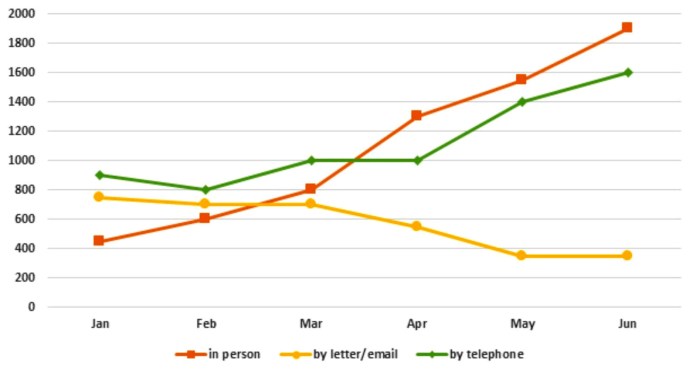
The line graph compares how many enquiries in a city received in person, and by telephone from January to June 2011. The initial impression from the chart is that the number of enquiries the Tourist Information Office received in person and by telephone saw upward trends, whilst that by letter showed an opposite pattern. It is also clear that enquiries in person had the fastest growth, surpassing the other two to become the prevalent mode. During the first half of the period, topped the chart. The office received 900 calls for tourist information in January, which reached 1000 in March despite a marginal drop one month earlier. Meanwhile, the number of in-person queries doubled in March after starting from roughly 400. A downward trend, however, was recorded in the figure for the letter/email category, from nearly 800 to 700. During the latter half of the period, the number of enquiries made in person soared to 1900 and outdid that through telephone calls, which ranked second with . By contrast, the figure for letters/emails hit a trough of under 400 in May and plateaued at the end.
Tourist Information Office Enquiries in 2011
The graph below shows the number of enquiries received by the Tourist Information Office in one city over a six-month period in 2011.
Annotated response
7 correction notes
Overall assessment
Why this response received Band 7.5
The response presents an accurate, well-selected account of the graph with a clear overview of the contrasting trends and correct key figures, which is its strongest aspect. The main limitation is occasional looseness in word choice and phrasing, such as 'outdid' and 'the prevalent mode', alongside a slightly imprecise description of the in-person increase.
IELTS criteria
How each score was decided
Task Achievement
7.5The response covers all three categories across the full period with a clear overview of opposing trends and largely accurate data, with only minor imprecision such as describing the rise from about 450 to 800 as doubling.
Coherence and Cohesion
7.5The response is logically organised into time halves with effective referencing and cohesive devices, though transitions are at times slightly mechanical in framing the two stages.
Lexical Resource
7.5Vocabulary is flexible and mostly precise, using terms like 'hit a trough' and 'plateaued', but a few expressions such as 'outdid' and 'the prevalent mode' are less natural or exact.
Grammatical Range and Accuracy
7.5A good range of complex structures is used with generally strong control, including relative and concessive clauses, with only occasional awkward phrasing such as 'the by-telephone category topped the chart'.