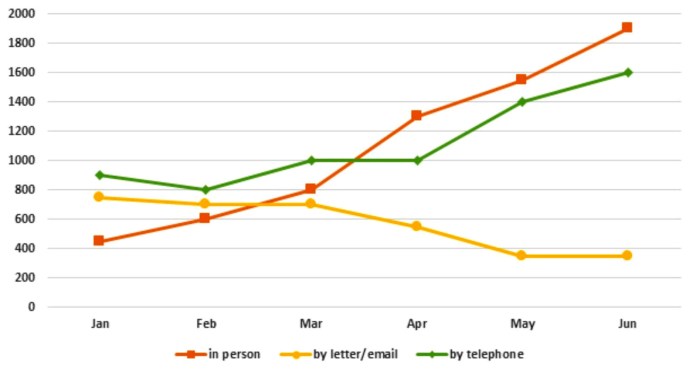
Tourist Information Office Enquiries in 2011

The graph below shows the number of enquiries received by the Tourist Information Office in one city over a six-month period in 2011.

IELTS Academic Writing Task 1 question image

Annotated response

5 correction notes

Showing 5 correction notes.

During the first six months of 2011, the line graph compares the number of questions received by one particular Tourist Information Office via three different channels: telephone, letter/email, and . Overall, the office received significantly more inquiries via phone and directly from tourists, as opposed to a gradually declining preference for over the time period provided.

Tourists called the office with about 900 questions, which was the highest number in January. This figure then fell by 100 before rising to 1000 in March and April, followed by a sharp increase to around 1600 inquiries in June. Similarly, the number of in-person inquiries increased the most, from 450 to 1900, making face-to-face communication the most common method of obtaining travel information.

The trend in written inquiries was the polar opposite. After remaining relatively stable at around 700 questions for the first three months, the number dropped to just 350 questions in May and June.

Overall assessment

Why this response received Band 7.0

The report clearly contrasts the rising in-person and telephone totals with the decline in written enquiries. Most figures and the overall organisation are effective. The main issue is the telephone timeline, which places March in both the fall and subsequent rise. The approximate early figure for written enquiries is reasonable, while a few expressions could be more natural.

IELTS criteria

How each score was decided

Task Achievement

7.0

All three channels are described with a clear overview and mostly accurate figures. The telephone sentence is internally inconsistent about February and March: the fall occurs in February, followed by a rise in March. The qualified description of early written enquiries as around 700 is a reasonable approximation.

Coherence and Cohesion

7.0

Ideas are logically sequenced across clear paragraphs with effective linking such as 'Similarly' and 'the polar opposite', giving a generally clear progression throughout.

Lexical Resource

7.0

Vocabulary is flexible and largely precise for describing trends and channels, with natural phrases like 'sharp increase' and 'gradually declining', though a few expressions such as 'mailing platforms' are slightly awkward.

Grammatical Range and Accuracy

7.0

A good range of structures is used with consistent accuracy, including complex comparative and participle constructions, with only minor slips that do not impede meaning.