
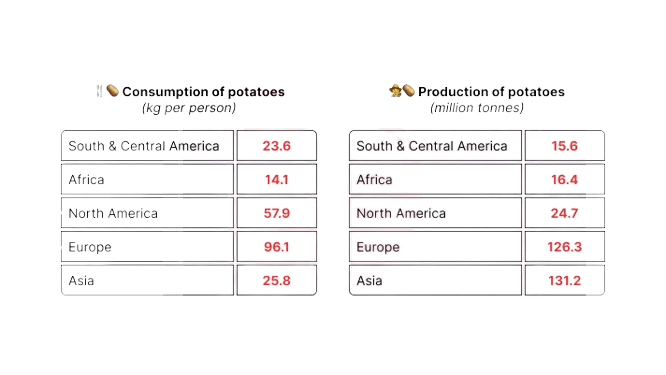
The tables illustrate the consumption and production of potatoes in various regions across the globe in 2006. Overall, Europe had the highest potato consumption per capita, although its production was slightly lower than Asia’s, which led the global production figures. In contrast, South and Central America, along with Africa, had the lowest figures for both consumption and production. In terms of potato consumption, Europe was the largest consumer in 2006, with an average intake of 96.1 kilograms per person (kg/capita), more than any other region. North America followed with 57.9 kg/capita, which was the average consumption in both Asia and South and Central America, where the figures stood at approximately 25 kg/capita. Africa recorded the lowest consumption at just 14.1 kg/capita. Turning to potato production, Asia ranked as the top producer with an output of 131.2 million tonnes (Mt). Despite Europe’s significantly higher per capita consumption, its production was the second-largest globally, at 126.3 Mt. North America, South and Central America, and Africa produced substantially less, with their totals ranging between 15 and 25 Mt, placing them at the bottom of the list.
Potato Consumption and Production by Region in 2006
The tables below provide information about the consumption and production of potatoes in five parts of the world in 2006.
Annotated response
1 correction note
Overall assessment
Why this response received Band 8.0
The report provides a clear overview and separates consumption from production, using accurate figures and sensible grouped ranges for most comparisons. Its main factual weakness is the description of North America’s consumption as nearly double the Asian and South/Central American levels, when it is actually more than twice both.
IELTS criteria
How each score was decided
Task Achievement
7.5The report covers both tables with a clear overview and generally accurate figures or grouped ranges. However, 57.9 kg is more than twice the Asian and South/Central American figures, so nearly double is inaccurate. The approximation of those two figures as about 25 kg is otherwise reasonable.
Coherence and Cohesion
8.0Ideas progress logically from overview through consumption to production, supported by cohesive devices such as in terms of and turning to that guide the reader without overuse.
Lexical Resource
8.0Vocabulary is flexible and precise for data description, using terms like per capita intake, output, and ranked as the top producer, with natural collocations and only occasional slightly generic phrasing.
Grammatical Range and Accuracy
8.0A wide range of structures is used, including participial phrases and complex sentences, with accuracy and punctuation controlled throughout and only rare minor lapses.