Ethanol Biofuel Production Process

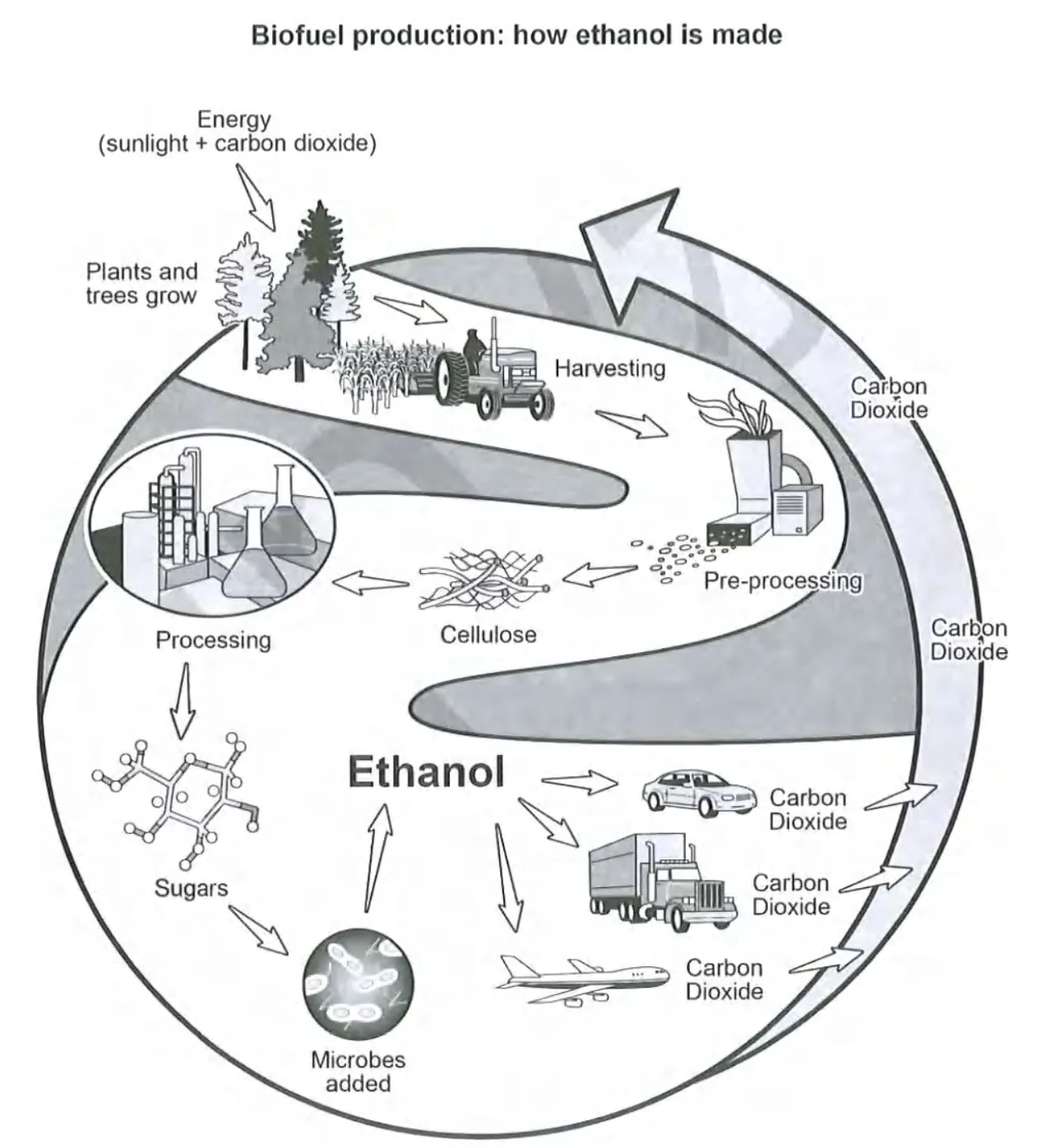
The diagram below shows how a biofuel called ethanol is produced. Summarise the information by selecting and reporting the main features, and make comparisons where relevant.

Cambridge IELTS 19 Academic Test 3 Writing Task 1 visual

Annotated response

10 correction notes

Showing 10 correction notes.

The diagram illustrates the cyclical process involved in producing ethanol, a type of biofuel, from plant materials.

Overall, the biofuel production cycle consists of three primary stages: harvesting and pre-processing plant materials, chemically converting them into ethanol, and utilizing the fuel for transportation, with the cycle then recommencing.

, plants and trees , fueled by sunlight and absorbing carbon dioxide from the atmosphere. , they are mechanically harvested and fed into a pre-processing machine. This machine breaks down the plant materials into smaller components, primarily cellulose, .

, the extracted cellulose , to convert it into sugars. These sugars are crucial for the subsequent fermentation process. Microbes, introduced into the sugars, facilitate fermentation, resulting in the production of ethanol .

Finally, the ethanol produced in the previous stage is utilized as a fuel source for various modes of transportation, such as cars, trucks, and . During this utilization phase, ethanol , releasing carbon dioxide back into the atmosphere. This carbon dioxide is then reabsorbed by plants and trees, restarting the cycle.

In conclusion, the production of ethanol from plant materials involves a cyclical process encompassing harvesting and pre-processing, chemical conversion into ethanol through fermentation, and utilization as a fuel source for transportation. This process highlights the sustainability of biofuels in reducing carbon emissions by maintaining a continuous cycle of carbon dioxide absorption and release.

Overall assessment

Why this response received Band 8.0

The response covers all stages of the cycle accurately and in clear sequence, with a precise overview of the three main phases and the carbon-dioxide loop. Its strongest aspect is the flexible, controlled language; the main limitation is a small number of interpretive details, such as describing the processing stage as occurring in a laboratory, that go beyond what the diagram shows.

IELTS criteria

How each score was decided

Task Achievement

8.0

The response covers every stage of the cyclical process with a clear overview and well-selected key features, though minor unsupported details such as transport to a laboratory and the concluding comment on emissions slightly extend beyond the visual.

Coherence and Cohesion

8.0

Ideas progress logically through the cycle with effective use of cohesive devices and clear paragraphing, with cohesion handled naturally rather than mechanically.

Lexical Resource

8.0

Vocabulary is flexible and precise for a process description, using terms like cellulose, fermentation, combustion, and byproduct accurately, with only a slight tendency toward over-formal repetition.

Grammatical Range and Accuracy

8.0

A wide range of structures, including passives, relative clauses, and participial phrases, is used flexibly and accurately with only rare, minor errors.