Location and Types of Dance Classes in Australia

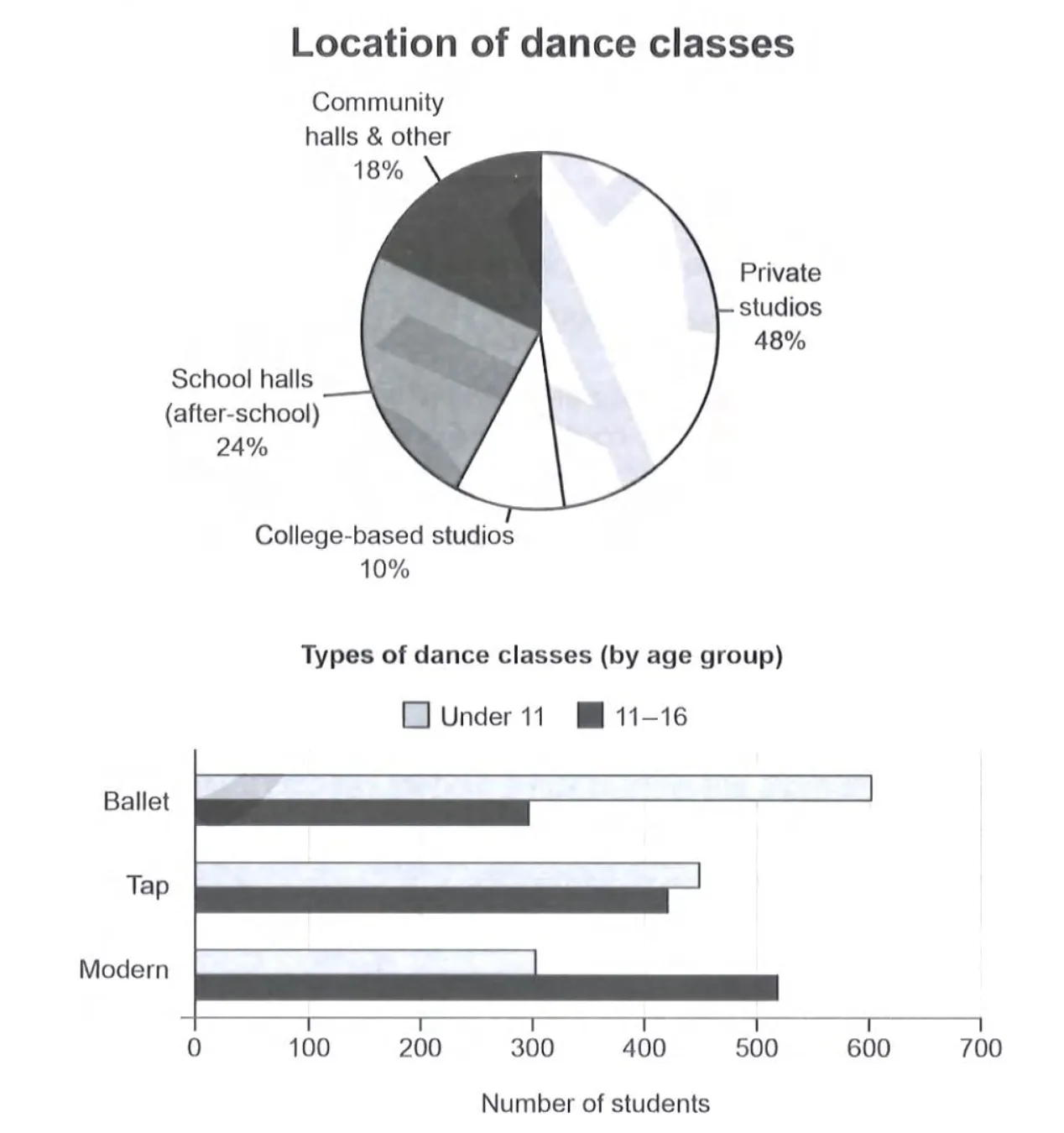
The charts below give information on the location and types of dance classes young people in a town in Australia are currently attending. Summarise the information by selecting and reporting the main features, and make comparisons where relevant.

Cambridge IELTS 19 Academic Test 4 Writing Task 1 visual

Annotated response

10 correction notes

Showing 10 correction notes.

The pie chart provides a breakdown of the venues where dance classes are held, while the bar chart illustrates the participation in three types of dance classes among young individuals in a specific Australian town.

private studios emerge as the most popular venue for dance classes, comprising 48% of the total, school halls used for after-school sessions at 24%. Community halls and other venues account for nearly one-fifth of dance classes (18%), while college-based studios represent the least chosen location, making up just 10%.

Regarding the types of dance classes attended, children under the age of 11 show a predominant interest in ballet, with 600 participants, which is twice the number in the 11-16 age group. Similarly, tap dancing sees a higher among younger children, with approximately 450 attendees, compared to 420 in the older age bracket. In contrast, modern dance classes attract more students aged 11-16, with over 500 participants, whereas only 300 younger children participate in this genre.

In conclusion, the data illustrates a preference for private studios as the primary venue for dance classes, while highlighting age-based differences in the across different dance types. Younger children predominantly ballet and tap dancing, whereas modern dance attracts of older students in the surveyed Australian town.

Overall assessment

Why this response received Band 8.0

The response presents an accurate, well-organised summary of both charts, with a clear overview and correct data throughout, including sound comparisons between age groups. Its strongest aspect is precise data selection and range of comparison language, while the main limitation is a slightly repetitive conclusion that restates rather than adds value.

IELTS criteria

How each score was decided

Task Achievement

8.0

The response covers all key features of both visuals with accurate figures (48%, 24%, 18%, 10%; ballet 600 vs 300; tap ~450 vs 420; modern 300 vs 500+) and a clear overview of the main patterns, with no invented data.

Coherence and Cohesion

8.0

Ideas progress logically through a clear introduction, overview, and body paragraphs organised by chart, with effective cohesive devices such as 'Similarly' and 'In contrast', though the conclusion somewhat repetitively restates earlier points.

Lexical Resource

7.5

Vocabulary is flexible and precise, using natural collocations like 'breakdown of the venues', 'predominant interest', 'participation rate', and 'age-based differences', with only minor repetition of terms such as 'participants' and 'venues'.

Grammatical Range and Accuracy

8.0

A wide range of structures is used with strong control, including accurate relative clauses, comparisons ('twice the number', 'compared to'), and contrastive constructions, with only rare, non-impeding slips.