Location and Types of Dance Classes in Australia

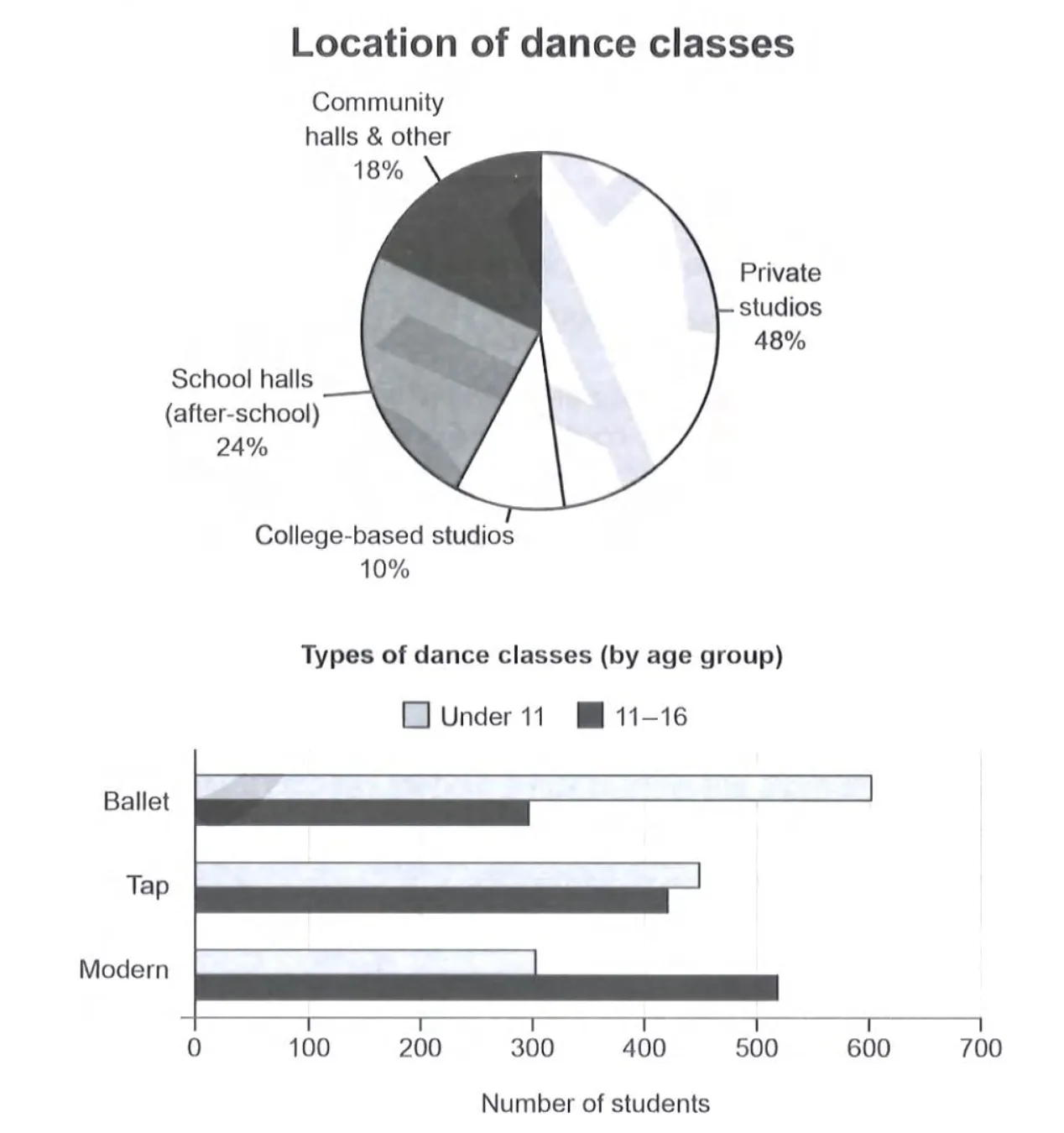
The charts below give information on the location and types of dance classes young people in a town in Australia are currently attending. Summarise the information by selecting and reporting the main features, and make comparisons where relevant.

Cambridge IELTS 19 Academic Test 4 Writing Task 1 visual

Annotated response

10 correction notes

Showing 10 correction notes.

The pie chart where young people in a town in Australia currently attend dance classes, while the bar chart illustrates the types of dance classes they take, under 11 and 11 to 16 years old.

Overall, private studios are the most popular location for dance classes. , whereas older students are more likely to

nearly half (48%) of dance classes are held in private studios, . come second, accounting for 24%, which is exactly half the figure for private studios. Community halls and other locations while college-based studios make up the smallest proportion at just 10%.

The bar chart shows clear differences in dance class preferences by age. Ballet is the most popular among children under 11, the number of those aged 11 to 16. Tap dancing is slightly more common in the younger group (450 students) than the older one (420). In contrast , modern dance is most popular among 11- to 16-year-olds, with 520 students taking part, significantly more than the 300 in the under-11 group.

Overall assessment

Why this response received Band 7.5

The response covers both charts fully and accurately, with a clear overview and well-chosen comparisons such as ballet being double the older group's figure. Its strongest aspect is precise, well-integrated data selection; the main limitation is somewhat routine linking language and occasionally safe phrasing that keeps the writing below the highest bands.

IELTS criteria

How each score was decided

Task Achievement

8.0

The response covers all four locations, all three dance types, and both age groups with accurate figures and valid comparisons, and it presents a clear overview, leaving only minor opportunities for deeper synthesis between the charts.

Coherence and Cohesion

7.0

Information progresses logically through a clear introduction, overview, and body paragraphs with effective sequencing, though cohesion relies on fairly mechanical linking phrases such as 'In terms of' and 'In contrast'.

Lexical Resource

7.0

Vocabulary is appropriately precise for reporting data, including phrases like 'accounting for', 'represent', and 'categorized by', but the range is solid rather than flexible or sophisticated.

Grammatical Range and Accuracy

7.0

Sentence structures are varied and largely error-free, including complex relative and comparative constructions, with only a minor spacing lapse after 'In contrast' and generally controlled rather than fully flexible grammar.