Monthly Price Changes of Three Metals in 2014

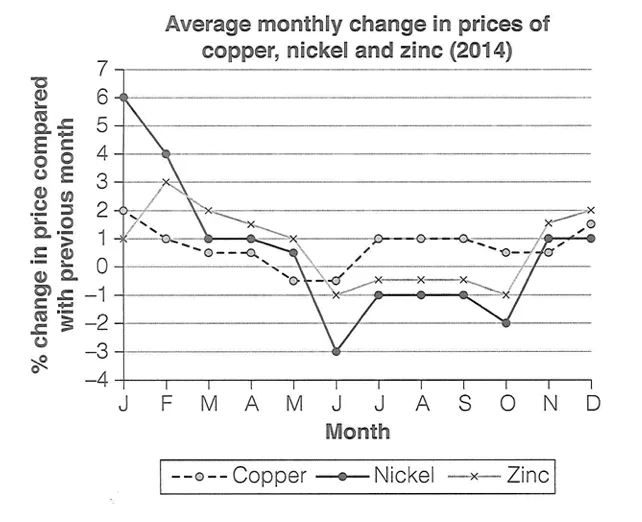
The graph below shows the average monthly change in the prices of three metals during 2014. Summarise the information by selecting and reporting the main features, and make comparisons where relevant.

Cambridge IELTS 18 Academic Test 4 Writing Task 1 visual

Annotated response

18 correction notes

Showing 18 correction notes.

The line chart shows how the prices of copper, nickel, and zinc changed each month in 2014. Copper and nickel prices went down overall, while zinc prices went up slightly. Nickel had the most significant price fluctuations between months.

In January 2014, nickel prices increased by 6% compared to the previous month, which was . However, nickel prices by March and reached a low of -3% by June. The changes for copper and zinc were less dramatic, with zinc seeing a 3% increase in February before a downward trend for the first half of the year. Copper prices also fell,

nickel prices continued to decline, except for Copper prices remained stable around 1% from July onwards, Zinc prices had a for most of the latter part of the year, followed by in December, which was the highest point reached among all the prices.

Overall assessment

Why this response received Band 7.0

The strongest aspect is the clear, well-organised reporting of the three metals' monthly price changes with a relevant overview and mostly accurate data selection. The main limitation is the occasional inaccuracy, including the claim that December's zinc figure was the highest point of the year despite nickel's 6% rise in January, alongside some imprecise wording.

IELTS criteria

How each score was decided

Task Achievement

6.5

The response covers the key trends across the year with a clear overview and largely accurate data, but the unsupported claim that zinc's 2% December rise was the highest point of the year conflicts with nickel's 6% January figure and the slightly imprecise description of zinc's mid-year values limit achievement.

Coherence and Cohesion

7.0

The information is logically sequenced across three clear paragraphs with a logical half-year division, and a range of cohesive devices is used naturally without overuse.

Lexical Resource

7.0

The vocabulary is sufficiently flexible for the task, using terms like 'fluctuations', 'dramatic', 'decline', and 'surge' appropriately, with only minor imprecision such as 'minerals' instead of metals and some reliance on trend verbs.

Grammatical Range and Accuracy

7.0

A variety of complex and simple structures is used with good control, including comparative clauses and time references, and errors are rare and non-impeding.