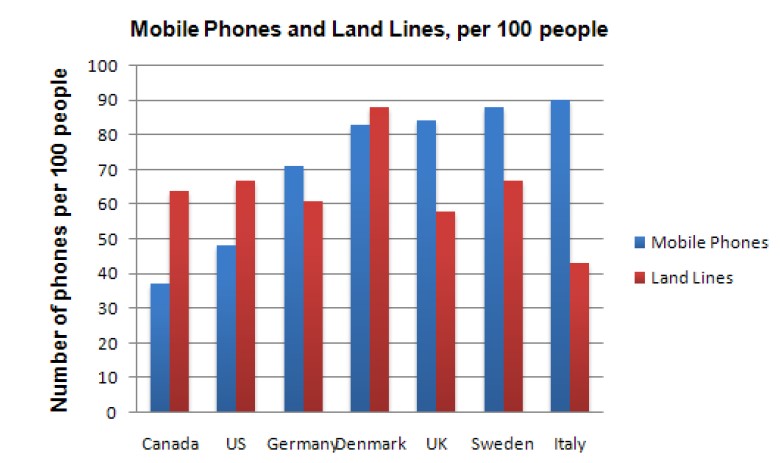
Mobile Phones and Landlines by Country

The chart shows the number of mobile phones and landlines per 100 people in selected countries.

IELTS Academic Writing Task 1 question image

Annotated response

10 correction notes

Showing 10 correction notes.

The bar graph gives the information about the individuals using mobile phones and landlines in different countries .

It shows that the trend of using mobile phones is , but in and Denmark, people use more landlines than mobile phones. In Italy, mobile phones are used by people at the maximum rate, but in Canada, it’s used least, but in Denmark of people use a landline, and the least used is in Italy.

With the advance in technology, people use more mobiles in different countries have different proportions. In Italy, 90 people use mobile out of 100, which is the maximum rate. In Canadians used minimum rate of usage of mobiles about 37%. Sweden UK Denmark German and US people using mobile in descending order about 87, 84, above 80, above 70 and less than 50 respectively of 100 people.

Whereas landline usage shows different trends among different countries, its usage trend is so low. In Denmark, the maximum number of people is near about 90 out of 100, and in Italy, . In Canada, the US, Germany, Sweden, landline usage , but UK people use about 57 out of 100 people.

Overall assessment

Why this response received Band 6.0

The response covers the main comparisons and most data points from the chart reasonably accurately, which is its strongest aspect. However, sentence construction is frequently faulty and some statements are awkwardly expressed or repetitive, which reduces clarity despite generally adequate vocabulary.

IELTS criteria

How each score was decided

Task Achievement

6.5

The response presents an overview of the mobile-versus-landline contrast and reports most key figures (e.g., Italy ~90 mobiles, Canada ~37, Denmark ~88 landlines, Italy ~43) with acceptable accuracy, but some statements are muddled, repetitive, or imprecise, limiting it to a clear-but-not-fully-developed achievement level.

Coherence and Cohesion

6.0

Ideas are arranged in discernible stages with basic linking devices, but progression is sometimes mechanical and cohesion breaks down in sentences such as the confusing overview and the mobile-usage paragraph.

Lexical Resource

6.0

Vocabulary is adequate for the task with some attempts at comparison language, though expressions like 'gives the information about' and 'at the maximum rate' show imprecision and limited flexibility.

Grammatical Range and Accuracy

5.5

Grammatical errors are frequent and sometimes obscure meaning, as in 'people use more mobiles in different countries have different proportions', 'In Canadians used minimum rate', and 'about 43 use landlines', alongside a restricted range of accurate structures.

Keep practising this question