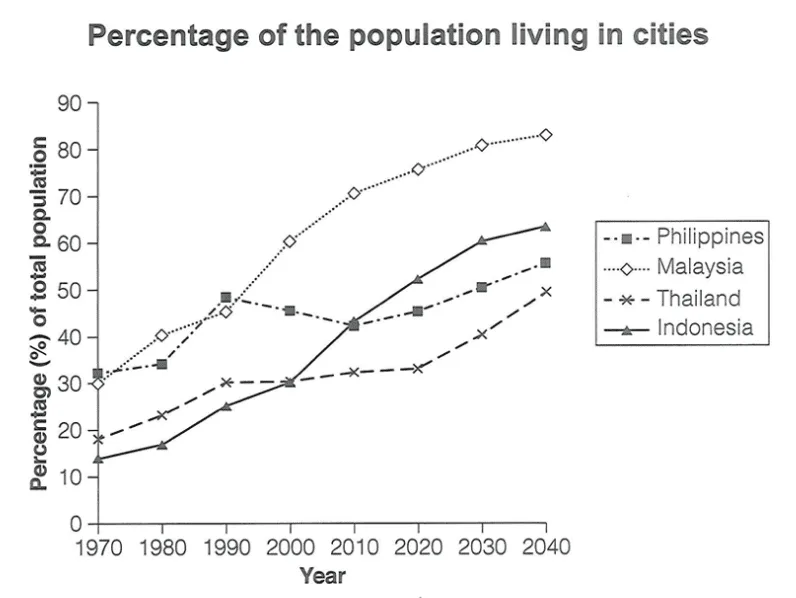
Urban Population Percentage in Four Asian Countries 1970-2040

The graph below gives information about the percentage of the population in four Asian countries living in cities from 1970 to 2020, with predictions for 2030 and 2040. Summarise the information by selecting and reporting the main features, and make comparisons where relevant.

Cambridge IELTS 18 Academic Test 1 Writing Task 1 visual

Annotated response

9 correction notes

Showing 9 correction notes.

The line chart delineates population trends as they relate to urban residency in four Asian countries starting in 1970 with projections through 2040. Looking from an overall perspective, it is readily apparent that living in urban areas will increase in each nation, By the end of the period, Malaysia will have by far the greatest proportion of living in cities.

In 1970, the percentages for urban residents in the Philippines and Malaysia were nearly equal (31% and 30% ), similar to the data for Thailand and Indonesia (19% and , respectively). Over the next twenty years, Malaysia’s percentage rose and fluctuated, switching relative positions with the Philippines around the 40% marker before beginning a dramatic surge in 1990 that is anticipated to continue and plateau at just over 80% by 2040. The Philippines, in contrast, declined moderately after 1980, though this figure will likely recover and end at a high of above 50% in 2040.

The statistics for urban residency in Indonesia have grown considerably, overtaking Thailand in 2000 (at 28%) and the Philippines in 2010 (at 42%). This pattern is projected to persist with the final figure the second highest among all nations at . Lastly, Thailand has experienced the most gradual and consistent increase to reach approximately 30% in the present day, with a more rapid rise to over 40% expected over the .

Overall assessment

Why this response received Band 8.0

The response covers all four countries with an accurate overview, well-chosen comparisons, and largely correct data drawn from the chart, showing strong task control. Its main limitation is a few minor imprecisions, such as understating Thailand's projected 2040 level, alongside occasional slightly mechanical signposting.

IELTS criteria

How each score was decided

Task Achievement

8.0

The response covers all four countries, gives a clear overview of the upward trend and Malaysia's dominance, and reports data that mostly matches the chart, with only minor imprecision such as understating Thailand's projected 2040 level.

Coherence and Cohesion

7.5

Ideas progress logically across a clear overview and country-by-country detail, with effective use of cohesive devices and referencing, though some linking is slightly formulaic.

Lexical Resource

8.0

Vocabulary is flexible and precise for describing trends and projections, including items like 'dramatic surge', 'fluctuated', and 'plateau', with only rare imprecision.

Grammatical Range and Accuracy

8.0

A wide range of structures, including accurate perfect and passive forms and complex subordinate clauses, is used with strong control and only occasional minor slips.