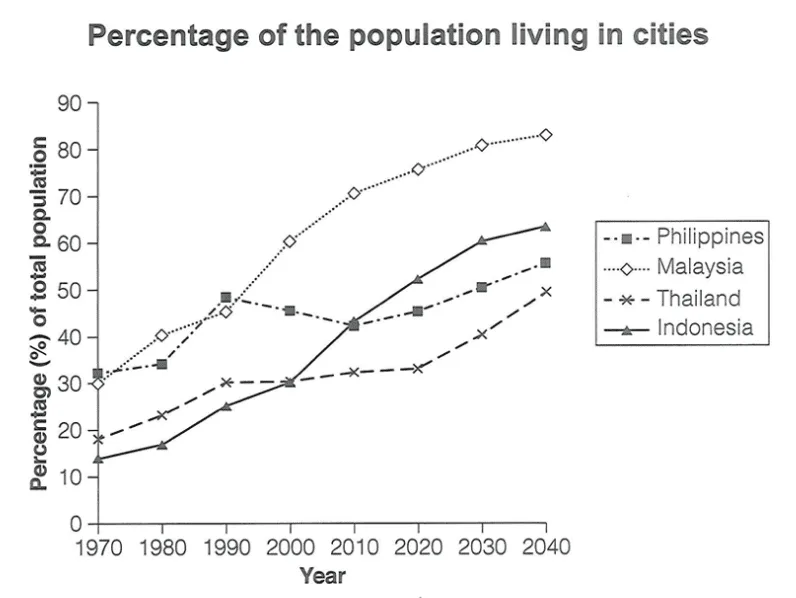
Urban Population Percentage in Four Asian Countries 1970-2040

The graph below gives information about the percentage of the population in four Asian countries living in cities from 1970 to 2020, with predictions for 2030 and 2040. Summarise the information by selecting and reporting the main features, and make comparisons where relevant.

Cambridge IELTS 18 Academic Test 1 Writing Task 1 visual

Annotated response

9 correction notes

Showing 9 correction notes.

The line chart shows how urban residency has changed in four Asian countries from 1970 to 2040. Overall, it is clear that urban living will increase in all countries, especially in Malaysia and the Philippines. By 2040, Malaysia will have the highest percentage of people living in cities.

In 1970, the Philippines and Malaysia had similar urban residency rates, . Thailand and Indonesia had lower rates, with . Over the next 20 years, Malaysia’s rate went up and down, surpassing the Philippines around 40% before rapidly increasing in 1990. It is projected to reach over 80% by 2040. , the Philippines saw a moderate decline after 1980 but is expected to recover and reach above 50% by 2040.

Indonesia has seen significant growth in urban residency, surpassing Thailand in 2000 (28%) and the Philippines in 2010 (42%). It is projected to , the second-highest among all countries. Finally, Thailand has experienced a gradual increase and is currently around 30%. It is expected to rise to over 40% .

Overall assessment

Why this response received Band 7.0

The response is well organised with a clear overview, effective comparisons, and a good range of vocabulary and grammatical structures. Its main limitation is a number of inaccurate figures and trend details, particularly for Indonesia and Thailand towards the end of the period, which weaken data reliability.

IELTS criteria

How each score was decided

Task Achievement

6.0

The response covers the main trends and offers a clear overview, but several data points are inaccurate or unsupported, such as Indonesia being projected at 55% instead of roughly 63%, Thailand rising to only over 40% rather than about 50%, and imprecise crossover years for Malaysia and Indonesia.

Coherence and Cohesion

7.0

Ideas are logically grouped by country and progression is clear, with cohesive devices such as 'Overall', 'On the other hand' and 'Finally' used naturally across cohesive paragraphs.

Lexical Resource

7.0

Vocabulary is flexible and appropriately academic, with varied phrasing such as 'urban residency rates', 'moderate decline', and 'surpassing', showing good control with only minor imprecision.

Grammatical Range and Accuracy

7.0

A wide range of structures is used, including accurate passive and future forms and complex sentences, with errors that are minor and do not impede meaning.