
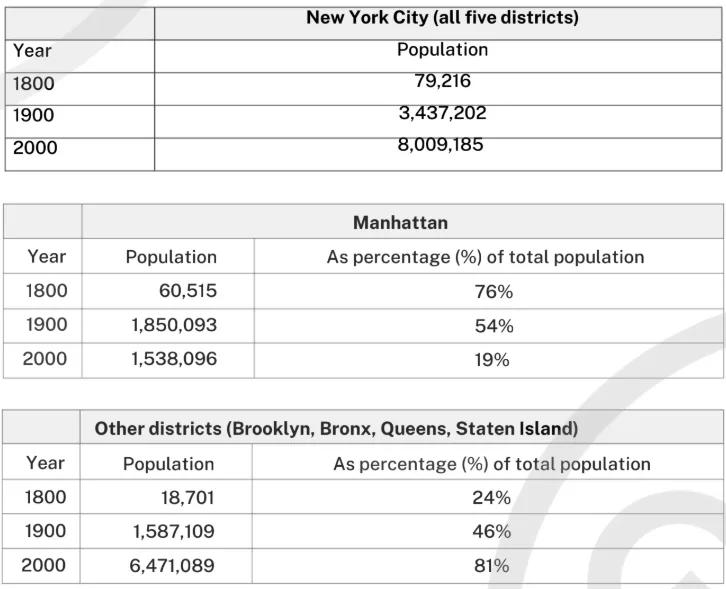
The tables illustrate how the total population of New York City and its five districts (Manhattan, Brooklyn, , Queens, and Staten Island) changed from 1800 to 2000.
Overall, while the total population of New York City and its four outer districts saw a considerable rise between 1800 and 2000, the population of Manhattan declined over the same period. The most striking feature is that the other districts underwent the most dramatic growth, becoming home to the vast majority of the city’s residents by 2000.
In 1800, New York City had a relatively small population of about 79,000, most of whom lived in Manhattan, which made up around three-quarters of the total. The remaining four districts together accounted for only 24%. By 1900, the city’s population had expanded remarkably to Manhattan’s population although its share declined to 54% as other districts began to attract more residents, reaching about 1.6 million in total.
By 2000, the total number of inhabitants had more than doubled again, reaching over 8 million. Manhattan’s population fell slightly to around 1.54 million, representing just 19% of the total. In contrast, the other districts experienced substantial growth, soaring to over 6.4 million people, or 81% of the city’s population.