Bamboo Fabric Manufacturing Process

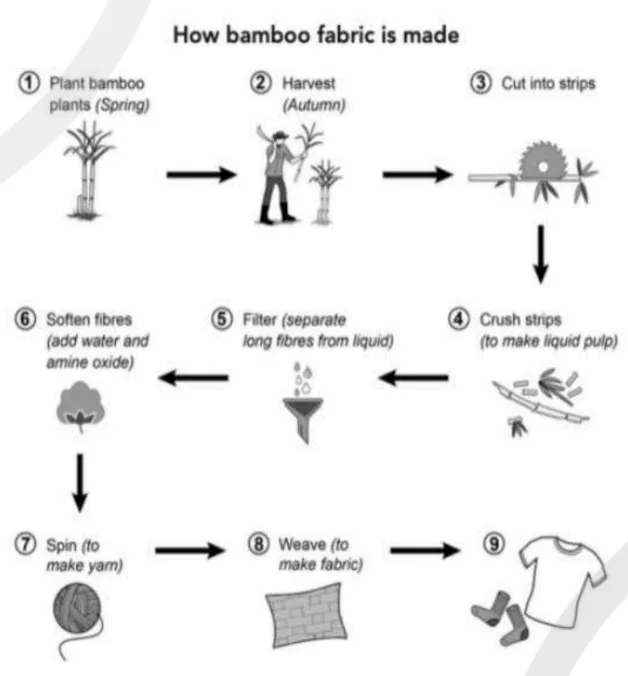
The diagram below shows how fabric is manufactured from bamboo. Summarise the information by selecting and reporting the main features, and make comparisons where relevant.

Cambridge IELTS 20 Academic Test 4 Writing Task 1 visual

Annotated response

10 correction notes

Showing 10 correction notes.

The diagram illustrates the process of manufacturing fabric from bamboo through .

Overall, the production of bamboo fabric is a combination of mechanical and chemical processes. It begins with the cultivation and harvesting of bamboo and concludes with the through spinning and weaving.

In the initial stages, bamboo , typically during the spring season. Once the bamboo has matured, it is harvested in the autumn. The harvested stalks are then cut into manageable lengths, collected, and transported to processing facilities. Following this, the bamboo is and mechanically crushed to produce a .

, the pulp undergoes filtration . These fibres are then softened by soaking them in a solution of water and amine oxide, which helps to break down the fibres for further processing. Once softened, the fibres are spun into yarn using specialized spinning equipment. Finally, the yarn is woven using industrial weaving machines to produce the finished bamboo fabric.

In summary, the entire process consists of that transform raw bamboo into usable textile material, combining natural resources with both mechanical treatment and chemical solutions.

Overall assessment

Why this response received Band 7.5

The response's strongest aspect is its clear, well-organised narration of the process with an effective overview and varied process vocabulary. The main limitation is a small but notable accuracy issue: the diagram contains nine stages ending with finished consumer products, while the response counts eight and omits the final items, alongside a few unsupported details such as transporting stalks.

IELTS criteria

How each score was decided

Task Achievement

7.0

The response covers the process clearly with an accurate overview and mostly accurate stage detail, but it miscounts eight stages against the diagram's nine and omits the final consumer products, while adding unsupported details like transport of stalks.

Coherence and Cohesion

7.5

The response is logically sequenced with a range of cohesive devices such as 'initial stages', 'following this', and 'subsequent stages', showing clear progression throughout.

Lexical Resource

7.5

Vocabulary is flexible and precise for a process description, including terms like 'pulp', 'filtration', 'amine oxide', and 'spun into yarn', with only minor mechanical lapses.

Grammatical Range and Accuracy

7.5

A wide range of passive and complex structures is used accurately and flexibly, with only occasional minor errors such as spacing and word-choice slips that do not impede meaning.