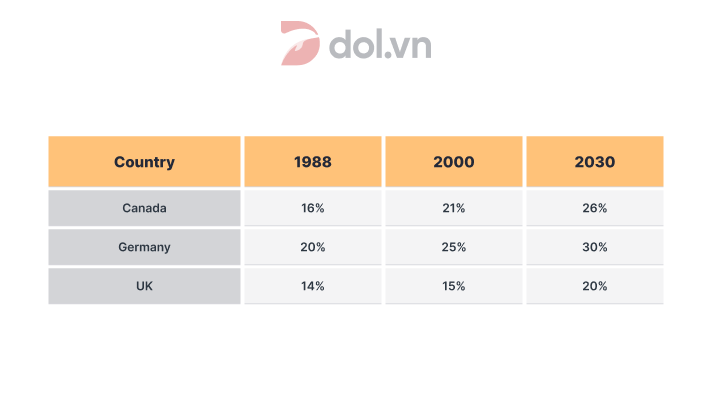
Elderly Population Percentage in Three Countries

The table below shows information and predictions regarding the change in percentage of population aged 65 and above in three countries.

Table comparing the percentage of people aged 65 and over in Canada, Germany and the United Kingdom in 1988, 2000 and 2030.

Annotated response

20 correction notes

Showing 20 correction notes.

The table details the percentage of and its predicted figures in three Canada, Germany and the UK between 1988 and 2030.

Looking at the , Germany of people aged 65 or older, whereas the reverse trend is true for the UK. the overall rising over the given period.

From 1988 to 2000, the elderly aged 65 or above constituted one-fifth of the population in Germany, as opposed to 16% and 14% in Canada and the UK respectively. The figures for Canada and Germany went up and 25% for the latter. The UK witnessed a less pronounced change with only a .

In 2030, the proportions of in are predicted to , 26% in Canada, 30% in in the UK.

IELTS criteria

How each score was decided

Task Achievement

7.0

The response covers all key features with a clear overview and accurate data, correctly reporting the 1988, 2000, and predicted 2030 figures for all three countries.

Next step
Slightly sharpen the overview by quantifying the upward trend and stating the predicted 2030 ranking explicitly rather than relying on body paragraphs.

Coherence and Cohesion

7.0

Ideas are logically organised into a clear introduction, overview, and two body stages, with cohesive devices used generally effectively.

Next step
Refine referencing and transitions, for example clarifying that the '5%' increases refer to the 2000-2030 period to avoid momentary ambiguity.

Lexical Resource

7.0

Vocabulary is flexible with good attempts at less common items such as 'constituted' and 'negligible', though some phrases are slightly unnatural.

Next step
Polish word choice, replacing imprecise expressions like 'senior demographics' and 'the proportions... are predicted to enjoy upswings' with more natural academic alternatives.

Grammatical Range and Accuracy

7.0

A variety of complex structures is used with generally good control, though errors such as 'the overall shares... keeps rising' and slightly awkward relative phrasing occur.

Next step
Proofread for subject-verb agreement and rework cumbersome constructions like 'the proportions of 65-year-old people and the older' for cleaner grammar.

Overall assessment

Why this response received Band 7.0

The strongest aspect is the accurate selection and comparison of the table's key data, with a clear overview and correct figures throughout. The main limitation is occasional grammatical and phrasing imprecision, such as subject-verb agreement and slightly forced lexical choices. The highest-priority improvement is refining grammatical accuracy and polishing word choice to achieve a more natural, controlled academic style.